
TableTopTakes: The Great Split
As I’ve gotten a chance to play The Great Split by Horrible Guild more, and at more player counts, it’s a game that intrigues me. And it is a game that has one element to it that I really like, the do one simple thing on your turn that requires a lot of thought. It’s not uncommon for board games to give you a lot of simple things with obvious choices, but when you get a game with hard choices but one thing, that I look out for.
How To Play The Great Split
The Great Split is an art collection game, but really, it is a game with tracks that you are going up on to optimize your score and have the most points at the end of the game. That’s the generic version of a lot of games. But The Great Split does it in a couple of interesting ways.
The main mechanism of The Great Split is “I split, you choose.” If you aren’t familiar, I create two groups of something, in this case, cards in my hand. You get to see those two groups and then pick the one that you want. I get what is left.
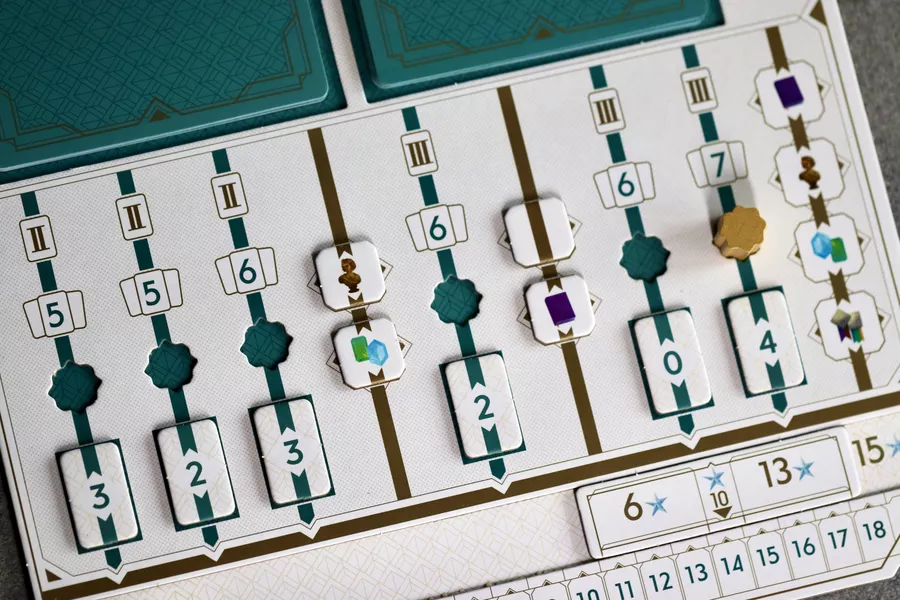
What you pick determines what tracks you go up on. You can go up on books, which have certain scoring thresholds when you score books. You go up on art where you score based off of how much art you own compared to the market. Or finally you push up the track on gems, either green or blue but ideally both, and you score twice your lowest gem total.
To go along with that, there are also tracks for contracts and coins. Contracts are end game scoring that triggers based off of how many contracts you’ve gotten in a particular area times how much those contracts are worth. So if I have 5 green gem contracts and I got my green gem contracts to be worth 3 points, I get 15 points. And with coins, they have contracts as well, but you can “spend” money to move up on other tracks as well.
The game plays over a number of rounds. And like I said at the beginning, the player with the most points wins.

The Details
So, as I’ve started doing, let’s look at what the box says.
For players it says 2-7 and the Board Game Geek community says best at 4-6. I think it would be fine at 4-7 players. And I know from playing it at 3, it’s still fun. But there is a difference. With more players more cards get into the rotation so you see more options. That is a big benefit with more. I don’t know that I really want to play it with two players.
It also says it plays in 45 minutes, and that is close. I think it is a bit longer than that. But the core mechanics are of the game are simultaneous. I only have played when I taught new players. I think with players who know the game, it might hit that time range. The game is only 7 rounds, plus three spots to score.
And finally, they say it is for 8+. Now as always a caveat with this. It is more about safety, but, The Great Split is language independent and has it’s one core mechanic. An adult might need to help with scoring, but I can see a younger kid playing it, say eight. They might not get all of the rules and nuisance of the game, which is to be expected.
What Doesn’t Work?
This is a very thinky game. And as a player you make a decision at times that might not be perfect for you. And because The Great Split is so thinky, someone who tends towards analysis paralysis and taking long turns will slow the game down. It is noticeable when it is there turn. But in a game with simultaneous play, it is going to be more noticeable. So be aware of that with The Great Split.
What Works?
The main mechanism in the game is amazing. I love I split you choose. And this game is that distilled. Yes, there are the tracks and they do create combos. But the main part of the game is I split my cards and you pick from those two splits. And that decision space is so good and so simple in this game. But when you split the cards, you worry that you either made the split too good to get back what you want. Or you didn’t make it good enough.
I also think that the tracks work well. They are not complex and basically you teach the game quickly. There is some to go over, but once you teach the player board, you teach the rest of the game in round one. So it is not a complex game but one that is fun to teach and play that way. Plus the combos in the game are simple in a good way. I hit this point on the coins, I advance two in another area.
The scoring is also well done. The Great Split is scored three times. Though what you score the first two times can vary. You score each of books, art, and gems. But when you set up the game you don’t know if you score books and gems at the first scoring and then art at the second or maybe gems at the first and book and art at the second. It gives you shifting goals. And then you score everything at the end.
Who Is It For?
This is a tough part that I almost skipped. Mainly because the core decisions can be tricky in the game. It might feel like too much to a casual game. I think this is a good filler for heavier gamers but also a fun game who play games. But for them, it is going to be the game of the night versus a filler game. But it is an accessible game with no reading on cards and different symbols to help with color blindness. That is really nice.
Final Thoughts – The Great Split
I love this game. I think that it is clever in in what it does in the best way possible. When I said that I like a game that does one thing and makes it thinky, I’m not lying. The Great Split makes every choice matter. What I pass to you is important and how I pass them to you. But that is seven times I make that choice in the game. And seven times I pick from the cards someone passes me. It is smart in how it does that and then making the tracks simple, but still meaningful. If they were a hard puzzle as well, it’d be less fun.
My one concern hasn’t been played out yet. I worry about how well it will hold up long term. Not components wise they are great. But will The Great Split feel consistent through every play and eventually start to feel like there isn’t enough change? I don’t know. I suspect it might, eventually, but that is a long ways out. Why, because the core mechanism is so strong with I split you choose that it makes for an interesting decision every time.
My Grade: A
Gamer Grade: B+
Casual Grade: B-
Send an Email
Message me on Twitter at @TheScando
Visit us on Facebook here
Support us on Patreon here
Leave a Reply
You must be logged in to post a comment.