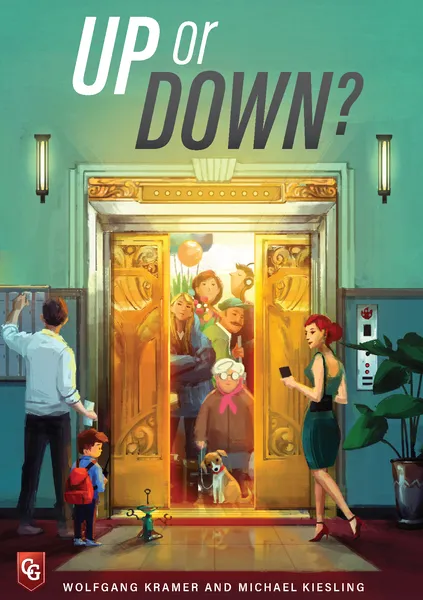
Up or Down – An Elevated Filler
Sometimes you just want to play a small board game. Or maybe it is that you have limited space in your luggage or where ever you are taking the game too. So you want something that offers some fun choices, has some “oh man” moments, and is easy to teach. So is Up or Down, a game in a very small box, a good game for that? Let’s find out how Up or Down is play and what works or doesn’t.
How To Play Up Or Down
Up Or Down is an open drafting game where you are trying to get numbers in order. If you want a board game comparison, it reminds me of Ohanami, but more complex drafting and simpler scoring.
In Up or Down you create three columns of cards and those are your scoring columns. But once you start building on a column the numbers either need to go up or down. So if you start at 9 a 1 or 2 is not going to be useful for that column. Now, if you can’t take play a card or don’t want to add it to a pile you can trash a pile and score 1 point per card.
But let’s talk about how to get cards. In this game you have a circle of cards from high to low. When you play a card you add it to the circle of cards. And you slot it between the numbers it falls in numerical order. So if you have a 42 it goes between the 32 and 45, for example. Then you take one of those two adjacent cards to add to your columns. Remember you add but you always add in the direction it was started in, either increasing or decreasing.
Then you draw a card and your 42 is added to the cards. The game goes like that until all the cards have been played. That means on your last turn you have a single card to play.
Scoring
So we know you get one point per card. But everyone ends up with the same number of cards. Each column is going to score one point per card in the column. And then you multiply that by the most common card color in the column. So a column with only five cards but four of them are the same color that is going to score you 20 points. As compared to a column with 10 cards but the most common color is only a two, that also gets you 20 points.
What Doesn’t Work
There is some luck in the game. Now I say some luck because you don’t know what your opponents are going to do. And the blind draw of cards, into your hand of three, can leave you stuck with numbers that are in a range that limits your options. Let’s say you get the 35, 42, and 44. In my example above, all of those cards fall between 32 and 45, so you only get two options on cards. That said, that happens to most people once during a game, so it’s not a massive limiting factor, and it’s all about pivoting.
What Works
Firstly, I like how simple the game is, but the card playing mechanism, in terms of the card you get for your column is clever. If you could take anything, it would be too easy. But it would also be too limited if you couldn’t take many cards. I think most of the time I have around 4 cards I can take that are unique when you play. Yes, it could be all six, but that’s unlikely with how the hands of cards work out.
The scoring is very good as well. I compare this game to Ohanami, but that game is much harder to teach the scoring. And while the drafting is simpler in Ohanami, the game takes longer to teach. So I like how Up or Down makes it that you just need to pay attention to colors. It is also going to make some interesting choices. Sometimes you look and you want to make a large jump to get the color you want. But when is the right time to make that jump, or is someone going to take the card you want.
Who Is Up Or Down For?
This is a good filler game. It is not extremely fast in it’s play, but it’s easy to teach and learn and turns are that fast. It is mainly that you go through a good number of cards. And the game is nice in that it gives you a long and short way to play it. So that is going to make the game tailored to how long you want it to be. I think that this is a solid filler for a good variety of players.
Final Thoughts on Up or Down
I enjoy Up or Down a lot in person and digitally on BGA. It is one of the BGA games that I find that I come back to pretty often. And because it’s so simple, it’s easy to jump back in without forgetting the rules to it.
The card playing is what really makes me like this game and why I picked it up. That manner of getting cards is just clever and it isn’t too complex. It feels like the right complexity and choice for the type of game that it is. I think that the same is true for the scoring of the cards in the game. Sometimes you make three really great columns of five cards, four of one color in each. Or sometime you have one column that scores one point per card and another that scores 4 points per card and has 10 cards.
I do really recommend this game. If you want a fun filler, this is a good choice. And it’s one that I think both my parents will understand and it’d be easy to play with them and other people who maybe don’t play as many games.
My Grade: B+
Casual Grade: A
Gamer Grade: B-
Luck: 2.5 out of 5
Strategy: 2.5 out of 5
Send an Email
Message me on X at @TheScando
Visit us on Facebook here
Support us on Patreon here
Leave a Reply
You must be logged in to post a comment.