TableTopics: Betrayal at House on the Hill
Betrayal at House on the Hill
Betrayal is a semi-cooperative, narrative-style game, in which everyone plays one of several different creepy adventurers.
And when I say creepy, I mean fairly creepy. There are twelve different characters that can be played — at most, six at a time. Two are little children — no one should ever let a child into a creepy haunted house, and if there is a little kid in there, they did it (every single time), if horror movies have taught us anything. Then there is the professor or priest, (depending on which side of that character card you play), the jock, the sorority girl, and the mystic. Basically standard fare for a horror film.
The group plays as a team of adventurers exploring an old haunted house. You use your speed points to move and explore new rooms, where you could find items, cause creepy events to happen around you, or find omens of the upcoming betrayal by some member of the party. Every time you play, you can build up the house differently. There are three different levels — you can access the ground floor and the upstairs immediately, but you have to find a way into the basement. Ideally, that way is the stairs, but you could also fall down there and get stuck.
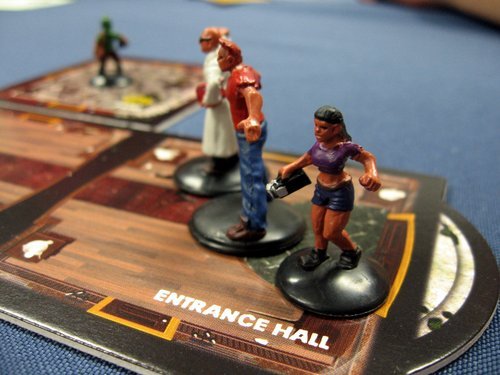
The omen mechanic is very interesting, and is what makes this game really strong. When someone enters a room containing an omen card for the first time, they must do what it says on the card (and will often get something out of it that is really good), but at the end, they must roll to try to avoid the haunt. The haunt is the point in the game at which one player could be revealed as the betrayer, and their character would then start trying to kill all the others.
To avoid the haunt after an omen card is drawn, the player must roll all eight dice that are included with the game. The dice each have two blank sides, two sides with one pip on them, and two sides with two pips on them. The goal is to have more pips showing than the number of omen cards that have come up, so at the beginning of the game, it is easy to keep the haunt from happening, but by the time you get to five or six omen cards, it starts to get more stressful, what with all the blank sides of the dice that could show up. If you roll fewer pips than there are omen cards, the haunt begins.
There is a haunt book included with the game that contains more than fifty different betrayal scenarios, and the haunt that is played for a particular game depends on which one item is found in the room the haunt happened in, and which omen was drawn that caused the haunt to happen. You then look at a table in the betrayal book, and it’ll tell you who is the betrayer, since none of the players (including the one who becomes the betrayer) know who it will be before the haunt occurs.
The book could give the name of a character as the betrayer, but if that character isn’t being played, it will give another condition that will determine the betrayer, like the player to the left of the one who caused the haunt to occur, or the player with the highest intelligence score on their character card. The player who has become the betrayer then leaves the room and reads their betrayal scenario, while the other players read about what they have to do to stop the betrayer.
And that’s what I’ll leave you with when it comes to this game. I’m not going to spoil any of the different betrayal scenarios that can happen. But I’ll talk a little bit more about the game itself — as betrayer games go, it is really solid. Since no one knows who the betrayer is going to be until the haunt occurs, everyone is equally suspicious while kind of wanting to work together at the same time. If the players are too spread out by the time the haunt happens, the betrayer might be able to easily complete their goal before another player can stop them, but if the players stay too close together, the betrayer’s scenario might allow them to just stack up monsters and kill everyone quickly. Also, if one person has too many items, it could be really bad if they become the betrayer — or, on the other hand, if they are killed off first by the betrayer. Who’s going to stop the betrayer then?
The game blends intensity, story, and two interesting game mechanics into a good game. But there are only fifty some scenarios — is that enough to make this game sufficiently re-playable? Well, I can’t say one way or the other completely. I’ve played the game four times so far, and have played one scenario twice, albeit with multiple years in between those times, so I didn’t remember all the details when I played it again. However, I do know that when a scenario you’ve played before comes up again, the haunt book tells you to just go on to the next one on the list and play that one. Because of this, I think that by the time you start repeating scenarios, it’ll be hard to differentiate them, and that along with all the different possible combinations of scenarios, items, rooms, and players that the game offers will still make it seem fresh.
This game is really one that most anyone can pick up quite quickly, as long as there’s also someone playing who already knows the rules. There are a number of rules, and once the haunt starts, the game can become more confusing, but the rule book is laid out nicely, so when you read about the haunt, or how to stop the betrayer, the new rules make good, clear sense.
Overall Grade: A
Gamer Grade: A
Casual Grade: B+
———-
Share questions, comments, or ideas for articles with us!
Email us at nerdologists@gmail.com
Follow us on Twitter at @NerdologistCast
Message us directly on Twitter at @TheScando and @Kefka73
Visit us on Facebook
Leave a Reply
You must be logged in to post a comment.