
TableTopTakes: Ascension
I’ve talked about deck building games a number of times before, and about how I’m not much of a fan of Dominion. Ascension is the game that I would use to introduce people into deck building, and I think it’s a more interesting deck builder, while still not giving people too much to do.
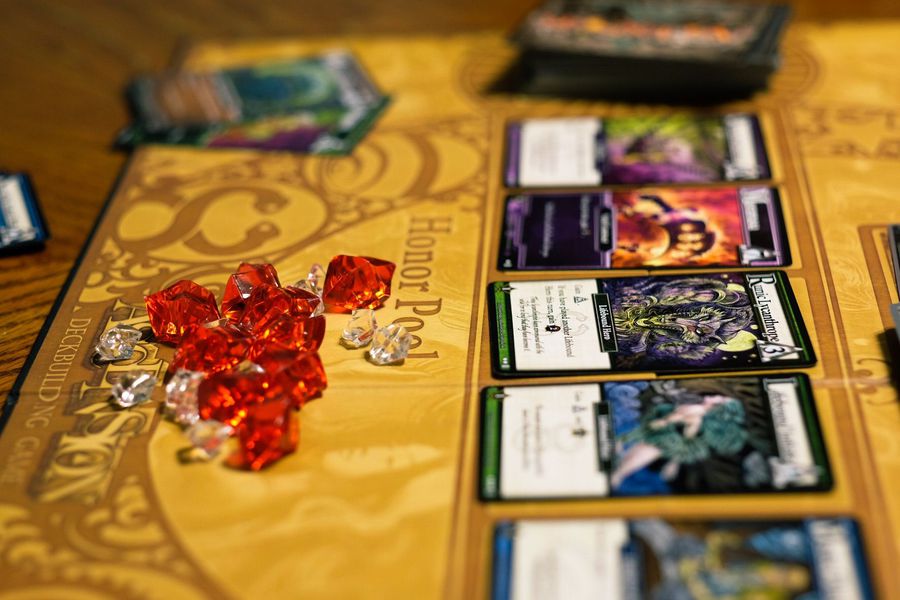
In Ascension, you are building your deck and gaining honor by purchasing cards and attacking monsters. The monsters give you honor when you kill them, but cards have an honor value on them as well, so you get points during the game from both areas. The cards that you purchase generally have some special text on them for what the cards do, it might give you money or attack power, but some cards will let you draw other cards, give you something more if you play a card from the same faction before it, or let you clear cards from your hand or deck that you don’t want.
Nothing about this deck builder is groundbreaking, it builds off of a lot of the ideas that Dominion has, but adds in two things that are different. First, there is attacking, it’s a small difference and basically it’s just another type of currency, but it’s something that base Dominion doesn’t come with. The other thing it adds in is a changing market. In Dominion, you have several stacks of cards you can purchase from, and those cards are going to be the same for everyone on all of their turns. In Ascension, you have a rotating market, there are six cards available which might include monsters to fight, as well as three basic cards that are always available. But what I see on one turn and then next turn could be completely different.
Now, is one of these better than the others, is having attacking and rotating market that much better than Dominion? Probably not, it’s going to be one of those things that some people will enjoy the puzzle aspect of having a single puzzle to solve in Dominion. I prefer the adaptive puzzle of Ascension. I might be starting out with a strategy in mind because of cards I get on my first couple of turns, but that strategy might have to change because of cards that come up later. The common example of this is that at the start of the game there are some cheap cards to purchase that help you purchase more cards, but no one is building up military might. Eventually, that market row might be all monsters, and now you have to add in military, or you’re limiting yourself on what you can do. In Dominion, unless you just are behind in terms of getting the ideal card choice and that deck runs out, you are pretty much in a single strategy throughout the game.
Another thing that I’ve alluded to and that I really enjoy in Ascension is the factions. There are four in the game, Mechana, Void, Lifebound, and Enlightened. Each of them does things a bit different. Mechana is focused on getting more Mechana cards, and in particular construct cards (I’ll come back to constructs). Void is much more about damage and gives you things to thin out your deck or hand. Lifebound tends to give you more purchase power but also cards might give you honor every time you play them, so another way to get honor besides on the card itself or killing monsters. Finally, Enlightened are all about setting up card draw and going through as many cards as you can on a single turn to build up your money and attack for each turn. I don’t know that the concepts for any of these different factions are all that unique, but it gives you some interesting combos. Maybe you just want to cycle through your deck and purchase things, Lifebound and Enlightened would do that well. Maybe you want to set-up a more consistent engine, Mechana and construct cards can do that.
Let’s talk a bit about construct cards, it’s another thing that I really like in this game. Constructs are cards that when you play them, they stay out in front of you giving you some benefit. It might allow you draw a card each turn, give you more money or attack each turn, or even help you buy more constructs, depending on the type of construct it is. This is probably Ascension’s biggest twist, and while other games have done that, like Xenoshyft: Onslaught if your defenders aren’t killed, but Ascension gives you cards that stick around that do a wide variety of things. I also like that there’s some tension with using constructs, because there are monsters that when killed will cause everyone else to keep only one construct and discard the rest or discard a construct. And losing a single one can at times break up your ideal combination that you have. And the Mechana faction is really focused on constructs, so if you want to get that going early and consistently for your strategy, you better have enough attack to kill those monsters on your turn, or you won’t be able to run that strategy as well.
One area that Dominion and Ascension are similar is that they both have a million expansions. I actually haven’t played any Ascension expansions thus far, and have played some Dominion expansions, probably bits and pieces of most. I don’t think that either of the games really need anything in those expansions to make the game playable. I’m going to be curious when I do get an expansion of two eventually for Ascension to see what it does for complexity of play. If it takes it away from being as much of an introductory deck builder, I am not going to be as interested in the expansions. That’s what I felt happened at times for Dominion.
Finally, I do want to touch on one of the biggest reasons, besides the rotating market, that I like Ascension better than Dominion. And that is theme. Now, Ascension, like Dominion, doesn’t have that much theme really in the game. But, I can use theme to teach Ascension. I can explain that the Mechana, Void, Lifebound, and Enlightened do because of the the theme. I can spin a story as to what you are doing attacking monsters, and the fantasy artwork is just more interesting of a theme to me. Generally, I think a fantasy theme is going to be a more attractive them for most people getting into gaming than trading in medieval times.
Like I said at the start, this is my preferred introductory deck building game. I like it for the fluctuating strategy that you need to employ, and I like that it’s a balancing factor in the game. In Dominion, for example, someone who is well versed in deck building and Dominion will win, but in Ascension, they might have an advantage, but it’s not nearly as major as it is in Dominion. Overall, I think that a lot of people are going to enjoy this game as a pretty simple but good deck building game. I do know, though, that this game won’t be for some who love Dominion, because of the things that I’ve mentioned.
Overall Grade: B
Gamer Grade: C+
Casual Grade: B+
Share questions, ideas for articles, or comments with us!
Email us at nerdologists@gmail.com
Message me directly on Twitter at @TheScando
Visit us on Facebook here.
Leave a Reply
You must be logged in to post a comment.