
TableTopTakes: No Thanks
No Thanks is an older game, but one that I just had the chance to pick-up and play. And for being a very simple game, it is a very fun game. Let’s take a look at what makes a game that is so simple work so well, if I can even truly define what makes it work.
How To Play No Thanks
No Thanks is a bidding and bluffing game where you are trying to score the fewest points possible over a set number of rounds. And the players set how many rounds they want to play. In a four player game, we played four rounds.
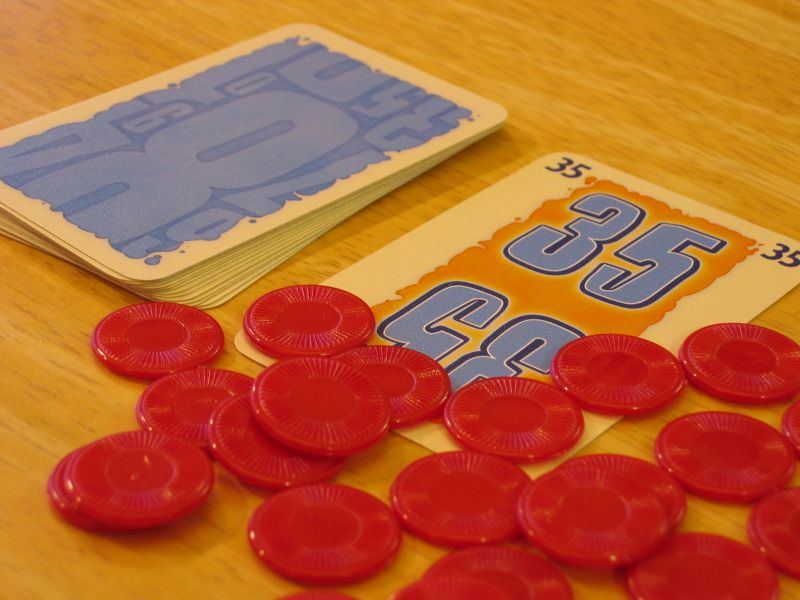
Each turn someone is the first player, they flip over a card, and decide if they want to take it. The cards range in number from 3 to 35. But there are 9 removed from the deck. Lower number cards are obviously better. But each player also starts with eleven chips. These chips allow you to say no thanks to a card and pass on it. But if you don’t have a chip, you must take the card. Whenever someone feels like there are enough chips on the card, and it is their turn, they can take that card and the chips.
Once all cards are gone through, players count up their points. Cards are worth the value printed on them. Unless, they are part of a run, then only the first card in a run is worth points. So, a run of 10, 11, and 12 is only worth 10 points. And any chips you have left are worth -1 point per chip. Fewest total points at the end wins the game.
What Doesn’t Work?
Honestly, this game is so simple that it works very well. I do think that some people can “crack” the game faster than others. For example, three of us were close in score and my wife had a much higher score. This comes down to just how people value the cards and chips. But that is a lot of what is good about the game too, so I’ll talk about that later.
I could also see some players getting frustrated with bad luck. In the game you remove nine cards, like I said, so it’s very possible that a player is shooting for a long run only to have a card missing in the middle. That increases scores fast when you can’t complete a long run. But that is a known part of a game and part of the pushing your luck in the game.
What Works?
Let’s start by talking about the valuation calculations that everyone is doing. I really like that aspect of the game. If I have a 32 and 33, taking a 34 is zero points for me. But for everyone else, that is 34 points. So I can make a decision to pass on it assuming it’ll come back around to me. Now, in a four player game, I get three additional chips. But then I let it go around again. Will it come back around, do players have chips left? It’s a judgement that I need to make to milk as much value as I can.
That piece of the game is fascinating to me. And it is tricky to get the value right. And sometimes you need to push your luck. If I already have the 32, and the 34 has 10 chips on it, do I take it risking that the 33 won’t be in there. If the 33 is in there, I now have 10 more chips to bid, a good chance I’ll get more chips with the 33, and then would only be scoring 32 points on those chips. But if it isn’t in the deck, now I have 66 points, with chips left to offset that scoring.
I also really like the speed of the game. The decision space is interesting. And the table talk is interesting, but the game still moves fast. Once in a while you reach a tough decision, but only two options exist. You either pass and put a chip on the card, or you take the card. So it moves around the table very quickly. And I think it’d scale well, as well. You just get less chips to start out with, which would change up how you value your chips.
No Thanks – Final Thoughts
This is a game that kind of seems like it shouldn’t work. The market value that is being created for each card depends on the group. Sometimes, depending on the card, the chips are more valuable to lose than others. So it might not work for some groups. But for myself, and the groups I play with, I think it will work most of the time. Because the game is an interesting bit of push your luck and bluffing as you go.
And while I think for some people the depth of No Thanks will be trickier to grasp, how to play it is so simple, and it can still get to the table easily. Even if people aren’t playing optimally, they can still understand what is going on. And it is still fun, because this game encourages table talk. Playing, we goaded players into taking cards, and talked about our decision making. it might not be ideal, keeping stuff hidden might be better, but it’s so like, we played it for fun.
My Grade: A-
Gamer Grade: B
Casual Grade: B
Have you played No Thanks? If you have, what do you think of it?
Send an Email.
Message me directly on Twitter at @TheScando
Visit us on Facebook here.
Support us on Patreon here.
Leave a Reply
You must be logged in to post a comment.