
Beyond The Box Cover – The Great Split
Often times I’ll be interested in a game just because of the cover. Or some element of the game that you can see looks intriguing. And The Great Split from Horrible Guild does a great job of drawing you in with an art deco cover and interesting look on it. Then you look at the game and it seems a bit minimalistic.
But for me the combination of the cover and the designers Hjalmar Hach and Lorenzo Silva and it being a Horrible Guild game put it over the top. In particular, I’ve found that I enjoy most Hjalmar Hach designs. So pair that with an amazing looking cover and a company that I like, I needed to check it out.
How To Play – The Great Split
The Great Split is not that difficult a game to play, though learning it on the fly there are a number of things to think about. It has a particular cadence to the game that you need to teach. But the main premise of the game is that you have a number of tracks that you want to go up on. Depending on the track(s) they score in different ways or give you different bonuses.
So, how do you go up on the tracks, it’s a simple I split, you choose mechanic. By that I mean that I have a had of cards, between five to seven in the game, and I am creating two groups of cards. Then I pass my wallet to you and you pick one of those groups. I get the other one back. At the same time everyone around the table is doing this, so I get a wallet of cards to pick from and pick one of the two groups.
You do that several turns and then at the end of the game you tally up your points. Whomever has the most points is the winner. And I can go into scoring more, but there is some to learn with that, but not too much.

What Am I Worried About?
So a bit of twist on how I normally do it, closer to the review. But I don’t want to fully dive into it, this is more of a first impressions. There are two things that stand out to me that I am curious about with the Great Split though.
Firstly, I wonder about the viability of this game at lower player counts. I enjoyed what the game does a lot, but I played it at 3. I wonder if 4-7 would be better. The game doesn’t really add much time to it the more people you play with. But at 2-3, you won’t see many cards. It adds a different element of strategy to it with how you can play your opponent, but you are going to get more unbalanced scoring.
I also want to know what it’s like to teach the game. I played at the time we were learning the game as well. And looking back on it, I think that I could make it faster and simpler for teaching. But there are a number of things to teach. There are six different sections you need to teach scoring on. At the same time, I think most of the things are pretty simple once you know them. And I don’t think I need to teach some elements of the game as the game suggests that you have someone “run” the game and turns.
What Have I Enjoyed?
I really enjoy the “I split, you choose” mechanic of the game. The game is really just that mechanic which doesn’t worry me too much because you’ll get variety each time you play in the cards you take. But it’s interesting to look at the board of the player you are passing to, the direction doesn’t change, see what they are picking, and try and create a combination where they pick something that gives you what you want plus just a little bit more.
Or it could be that you create a split where either one will work for you, but you’ve split up what they want in order to slow them down. The game seems simple, but you can really give someone what they don’t want to keep some scoring tracks in check if you split stuff up well.
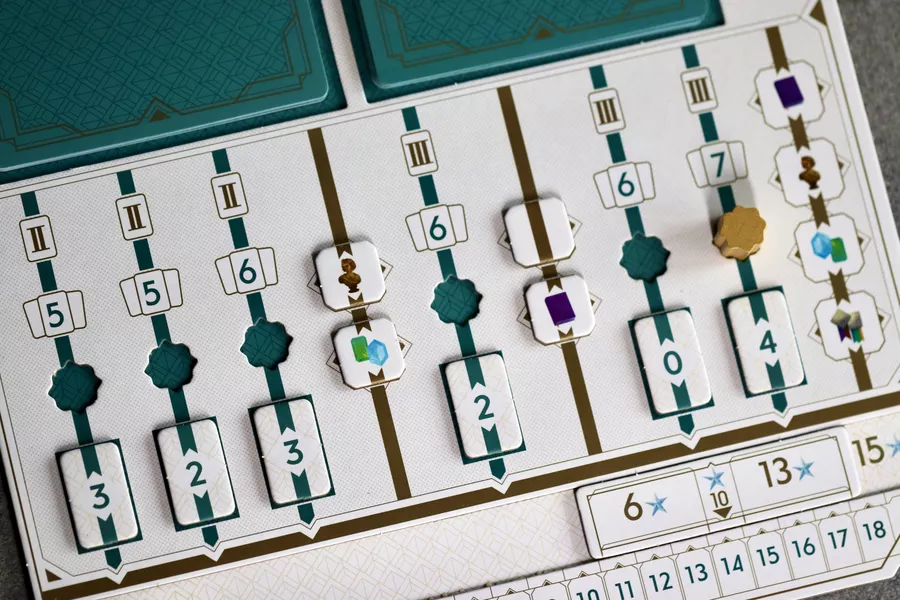
I also enjoy how the scoring works. Now, I won’t go into everything, but some of them are just how far you are up on the track, another has a sliding market, and another is the lowest of two tracks. But I’m more talking about how the game scores each section twice, minus contracts. So the three main tracks twice, once each mid game and once at the end of the game. But mid game you might score books and gems first and then art and nothing, or it might be books and nothing first and then art and gems. So when you score the first time might determine what you push for.
Final Thoughts – The Great Split
This is a very fun experience and I really enjoyed playing it once so far. I wonder how often I will get it played, though, because it is a game that seems to work better with more. And while I do have game nights, I feel like it isn’t one we’ll play all the time. But it fits into the same category, in my opinion as a game like Sushi Go Party or Seven Wonders.
With that, I mean that I can see playing it at higher player counts. And with more players, it is not a game that takes longer to play. I play it with three players, it goes as fast as the slowest player. I play it with 7 players and it still plays as fast as the slowest player. Now, the slowest player might be slower, but that is the restriction. So I really like that about the game. And I like it when I find a big group game that isn’t a party game.
Do you like The Great Split? Is it a game that you want to try? Let me know in the comments below.
Send an Email
Message me on Twitter at @TheScando
Visit us on Facebook here
Support us on Patreon here
Leave a Reply
You must be logged in to post a comment.