
Table Top Takes: SpellBook
When Phil Walker-Harding puts out a new board game, I am interested. He makes games that I would call simple, but with enough strategy to keep you interested. He even makes titles that show up at your Targets or Wal-Marts. Sushi Go Party! is probably my favorite of his, but he’s done other loved titles like Barenpark, Planted, Super Mega Lucky Box, and Summer Camp. His newest game, I believe, is SpellBook which is just coming out now. But there were copies of SpellBook at Gen Con and I grabbed one, so is it a good game?
How to Play SpellBook
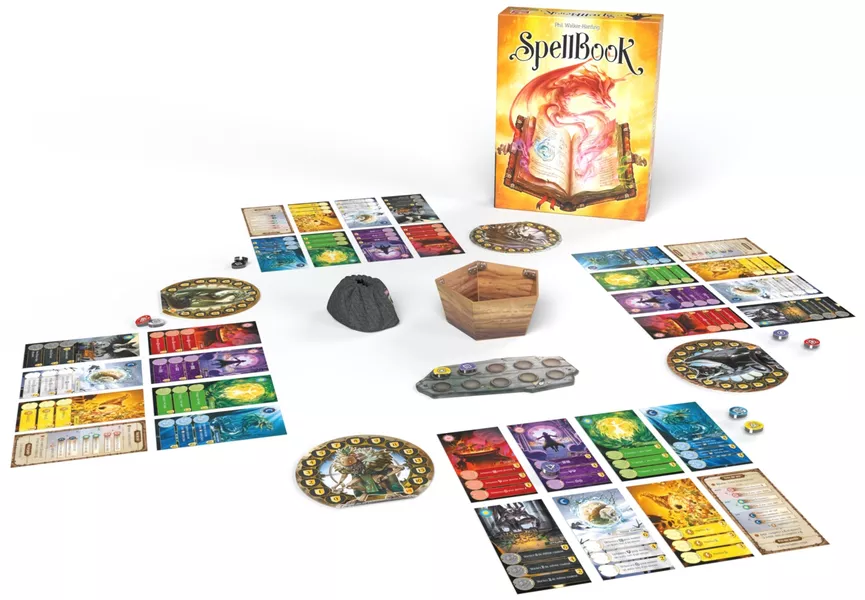
SpellBook is a game of collecting materia, basically components to use to cast spells or feed your familiar. So the main thing that you do is collect that materia in order to complete spells and get bonuses that will improve how you can cast spells or feed your familiar.
On your turn, and your turn is split into three parts, morning, day and evening, you do three actions. Each phase has two actions. Firstly, you can use a morning spell or collect materia. Then activate an day time spell or feed your familiar. Finally, an evening spell or learn a spell. Turns are pretty simple that way, just becoming more complex as you unlock more spells.
The trick, or one of them, is that you only can cast a spell once. Now, you can activate it more times, but you can only cast it once. So if I cast the blue spell and it’s a day action, let’s say, I can then use that spell at the level I cast it. But there are higher levels that might be better and I won’t be able to cast it at that level.
The game ends when someone has fully fed their familiar. Or when someone has cast all seven spells. Then everyone gets an equal number of turns and you tally up your points.
What Doesn’t Work
When I think of Phil Walker-Harding games, in particular Sushi Go Party!, there is depth there. But the turns are simple, you draft a card and once everyone has, you flip it out and play it. SpellBook is more complex than that. Now, it isn’t that complex because it lays out your actions clearly. But for some people, if they were hoping for a game to rotate in with Sushi Go Party!, they might be disappointed.
The same with the player count on this game. It’s a four player game, so unlike Sushi Go Party!, again probably the biggest frame of reference, it isn’t a game for large groups. Not a knock on the game, but a thing to acknowledge with people’s expectations.
Though, I will say, I think that this game compared to others, again Sushi Go Party! and Super Mega Lucky Box, it is a bit fiddlier. By that I mean that SpellBook just has more to keep track of. I wrote about the turn and what you can do. Well, there is also adding materia to a board, so really it’s four steps over your turn, and which ones you do offers a decision point each time. So it doesn’t fly along like you might expect it.
What Works
Now, to contradict some of my negatives, or really the preferences that people might have, I like that you have a number of choices on your turn. The biggest is getting that materia. Because that can set-up everything else that you do. And if you draw to blind, you might get exactly what you need, but it’s also worthwhile to build up an engine of actions to let you pick off the board and get exactly what you need.
Another huge thing about this game is what you’re going for in the game. There are multiple sets of spells. And it’d be easy to give SpellBook another expansion by just adding in another set or two of spells. Everyone always plays with the same spells, so how you activate them and complete them changes up your strategy. Some of that might be determined by what materia is out there, but some of it is looking at the spells and determining which one or ones are going to give you the engine you want to try.
And let’s talk about end game as well. Because the two different end triggers work well. I’ve had games where I went the familiar route. That gets you a lot of points, but it uses up a lot of materia. So you may not cast as many spells, which seems wrong for a game called SpellBook. But it is balanced so that you can go that way, the points will make it close and you might win. At the same time, if you build up a great engine of spells, you can complete them faster. So it gives you two real options to win the game and figure out how you want to do that.
Who Is It For?
I think that people who like Phil Walker-Harding games are going to find this one fun as well. I think it is a bit less streamlined than some. But not as a negative. It is almost a bit of a next step game for him. But not to the point where it is going to be too much or overwhelming for a player. Maybe someone who only plays a few games, but that’ll just be for a few turns, it shouldn’t be for a whole game.
So I think this is good game for playing with family and friends who might like board games but not play them too often. Or it may work well for a group who wants a bit more of a filler experience, but not a light mindless filler. In fact, it’s probably too long for a filler, but for a group who is playing a couple of heavy games in a day that last a long time, SpellBook would be a break in between.
Final Thoughts on SpellBook
I definitely enjoy this game. I think that figuring out the puzzle of how I want to collect and spend materia, whether that’s for a spell or the familiar is interesting. And I appreciate how well balanced it is. That isn’t to say that it’s a perfect game, but it’s one that I am glad I own. SpellBook is that nice weight that I’d say isn’t much more complex than a Ticket to Ride, but just a little bit more to offer a few more meaningful decisions.
And it is also a nice balance of luck, drawing out materia, and the ability to not focus on luck by how you complete spells. It might mean that you go slower to start to really get your engine going like you want, but that might be worth it in the end versus pushing your luck and hoping your draw the right colors. That is something I want to experiment with more.
Overall, I think that SppellBook will work for a lot of people. For heavier gamers, like a lot of Phil Walker-Hardings games it might seem too simple, but that is for gamers who like a lot heavier games. I think for most gamers it’ll be one that works well in a collection and offers good variety.
My Grade: B+
Gamer Grade: B-
Casual Grade: B+
Send an Email
Message me on Twitter at @TheScando
Visit us on Facebook here
Support us on Patreon here
Leave a Reply
You must be logged in to post a comment.