
Organizing Your Board Game Collection
I think this is a topic that I’ve talked about before. But I just went through my whole game collection and organized it again. The methods I use change from time to time, so let’s talk about what I went with and why I went with the organizing method I did. And what other ways might you organize your board game collection. Because I think for some people, organizing a big board game collection is a challenge in itself.
Why Organize Your Board Game Collection?
Maybe that’s the first big question to get answered. Why would one organize their board game collection? And for a lot of people it won’t be needed. I know a lot of people own the handful of games, or even twenty, that they really love. Well, twenty games fits into a closet and you can see them all.
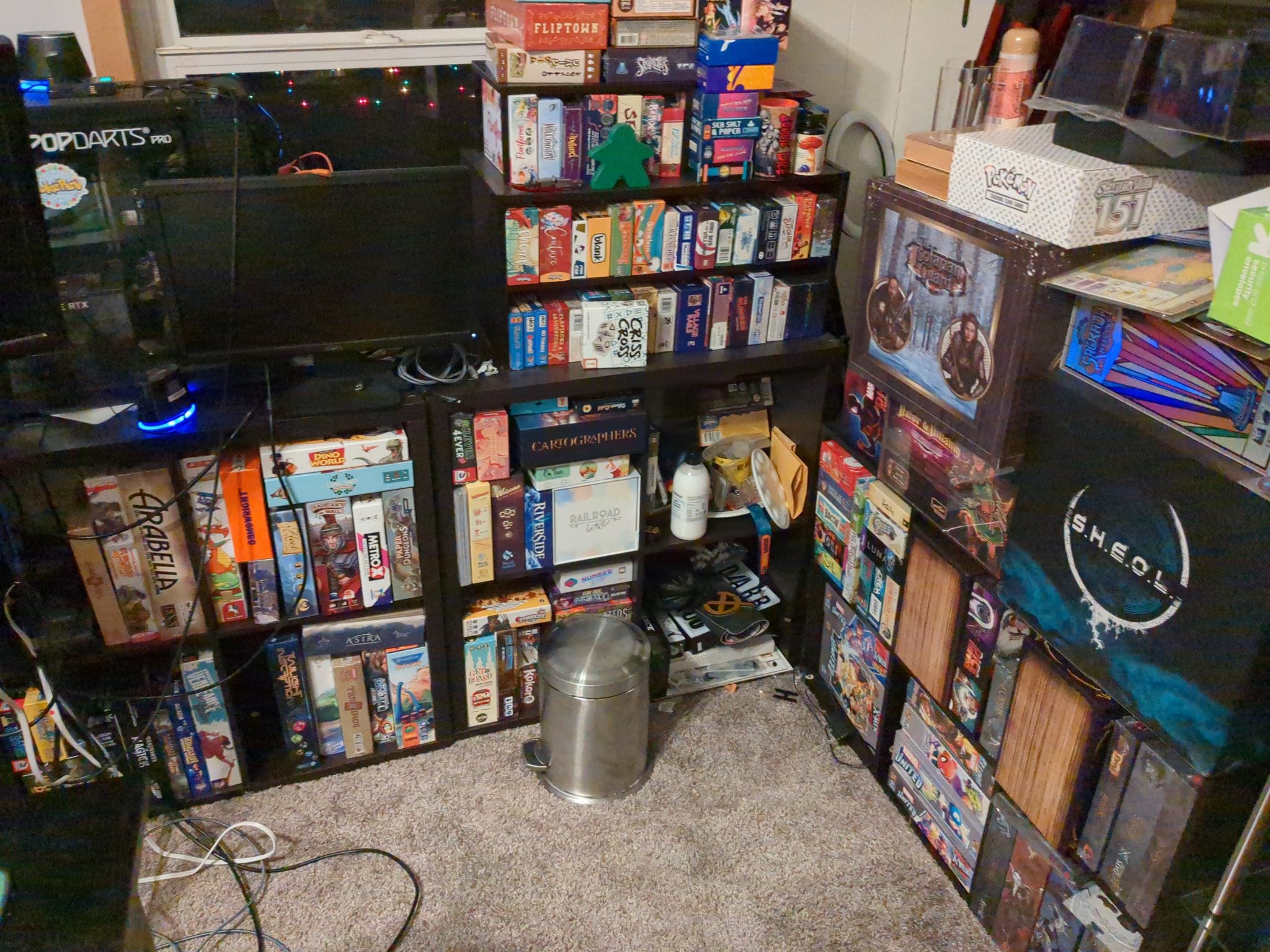
For myself, and looking at my stats on Board Game Geek, I own about 500 different board games. To go along with that, I own about 250 different expansions. I don’t always keep my expansion boxes, when I can combine I do. But that is still probably 600 to 650 unique boxes that I need to think about and know where they all are. And as I sell and buy games, that changes where things are. A new game comes in and it gets shoved into a pile or onto a shelf with some random games.
So for me, I organize to know where my games are. And I’ll get to how I do that later. Right now, immediately after organizing, I do not know where all of them are.
Ways to Organize
So let’s talk about how people might organize. And let’s start with the most space efficient way. I think that some people just organize to maximize how much they can fit in to a space. Not a bad way of doing it, it’s simple, but then nothing logically flows to a given location on your shelf. You need a way to know where a game is and where it goes back to, once you’re done playing it.
On the flip side, I think that some people don’t organize for another reason. It’s tricky to organize, and like I found out, when you do organize, it’s a maintenance project to get things back to their right spot. As you add new games, you need a cubby to place it in or a shelf to place it on. If you don’t have that, you often just stack them randomly.
So what are some other methods? I think there are three that a lot of people will consider and pick from.
Mechanisms
The first is mechanisms in a game. If I own 10 deck building games, I think I do, all ten go to the same spot or area of my game collection storage. That way, I know when I when I want to play a game of a certain style, I go to that are and I can look at all of them. This makes it easy to pick a game of a given style around the mechanisms in the game.
The downside is that a lot of games use different and multiple mechanisms. I own several deck builders that have things like campaign or push your luck in them. So which do they go with? I think that deck building is the main mechanism. But if someone were to come in and look for a game, well, that mechanism might be secondary to them.
That said, this is an element that I do use for sorting. Not all the time, but often, and I generally keep it to broader things. So roll and writes, all in one section. Trick-Taking games, all in a single section. And campaign or story games (even this one blends some) all in a single section.
Theme
Next up you might sort by theme. This is another fun method to do it because it lets you know what type of game you are getting into. All the fantasy games go in one spot and all the sci-fi go in another. There are now a ton of nature games, so they go in another area.
But like mechanisms, you get games that have multiple themes. Something might be fantasy and horror, so which does it go in. There are games that are horror without fantasy and vice-a-versa. So it’s a judgement decision as to where they go.
That said, if you sort it well enough you can figure out a lot of that so it makes sense. And I think that theme is one of those areas where you might look at it and say, what mood am I in, and by that you mean theme more often than, say, mechanism.
Right now, I don’t think I have anything sorted around the genre sort of theme. I think my story and adventure games being together almost counts for that, but not quite. That is the closest area though that the sorting makes sense for that.
Weight
Finally, I think of the weight of the game. Now, depending on how you anchor your shelves to the wall, it might be actual weight, put your heaviest games on the bottom. But what I want to talk about is the complexity rating of a game. Board Game Geek has a number assigned to this that people vote on. Let me quickly disclaimer that number, the more you play games, the easier games are to learn. So take that number with a grain of salt.
But sorting by weight is what I did a fair amount of as well. I sorted my more mid to light games into one area, my heavy games into another, with then my exceptions, like my story and campaign games, roll and writes, ana few others split into specific ways.
Why did I do that? Well, because some areas of games are harder to sort. And a lot of that is when you get into those games of if they are heavier or not. So sorting by weight lets me know what section to look at for a game night. When I do my big game night, party games, roll and writes, but also those lighter weight games, those work the best.

How Do You Know Where They Are?
So obviously, I own a ton of games. I own more games than most people do and less games than a good number of people do. But how do I know where my games are. Some of that is just guessing, I know it’s a lighter game, I look in those mid to light wait games.
But I also know that I own enough that I might never pull a game off the shelf if I don’t know where it is. So it’s a work in progress, but I’m trying to go through and document where everything is. Some of that is because while sorting how I did, I also tried to optimize for space. I did a solid job, not too many piles of games left on the floor. That said, it is now causing me to not know where games are as much.
So I could do a book, and I might even print off a book/binder for when people I play with are looking for a game. But I am currently creating a spreadsheet. I know the games I own. So I don’t need a picture or description, though, once in a while that might be handy. But with my shelf set-up, I can number shelves and then everything is grid based. So right now a game might be on shelf one, cubby A4.
Final Thoughts on Organizing a Board Game Collection
Obviously, this isn’t needed, and there isn’t a right way. The Brother’s Murph did a fun video one time where they organized them all into color, so it was a board game rainbow across their collection. That is a fun way to do it as well. I’d definitely need a spreadsheet to know where everything was then.
So organize how it makes sense to you. I think even when people do own twenty games, they often organize them in ways that make sense to them. It’s just that twenty games is a whole lot easier to keep track of than 500.
I also want to say, I think that it was a kind of therapeutic experience. I think I know most to all of the games that I own. So it isn’t a situation where I need to figure out what I own. But it is a good reminder to move stuff around and see games. Some of it is seeing games that I forgot where they were that I really love, or maybe weren’t in the forefront of my mind. But that might just be a me thing for a nice relaxing project.
How do you sort your games?
Send an Email
Message me on Twitter at @TheScando
Visit us on Facebook here
Support us on Patreon here
Leave a Reply
You must be logged in to post a comment.