
River Valley Glassworks – The Best Pieces Game?
It’s time to write about another game I picked up at Gen Con and that I’ve played a number of times now already. That is going to be River Valley Glassworks from Allplay. I skipped this game when it showed up on crowdfunding. But I got to demo it at Gen Con and then I played it multiple times since then so I’m very glad that I picked up my copy. You probably can already tell I like the game, but let’s talk about how it works and why I like it.
How To Play River Valley Glassworks
How To Win
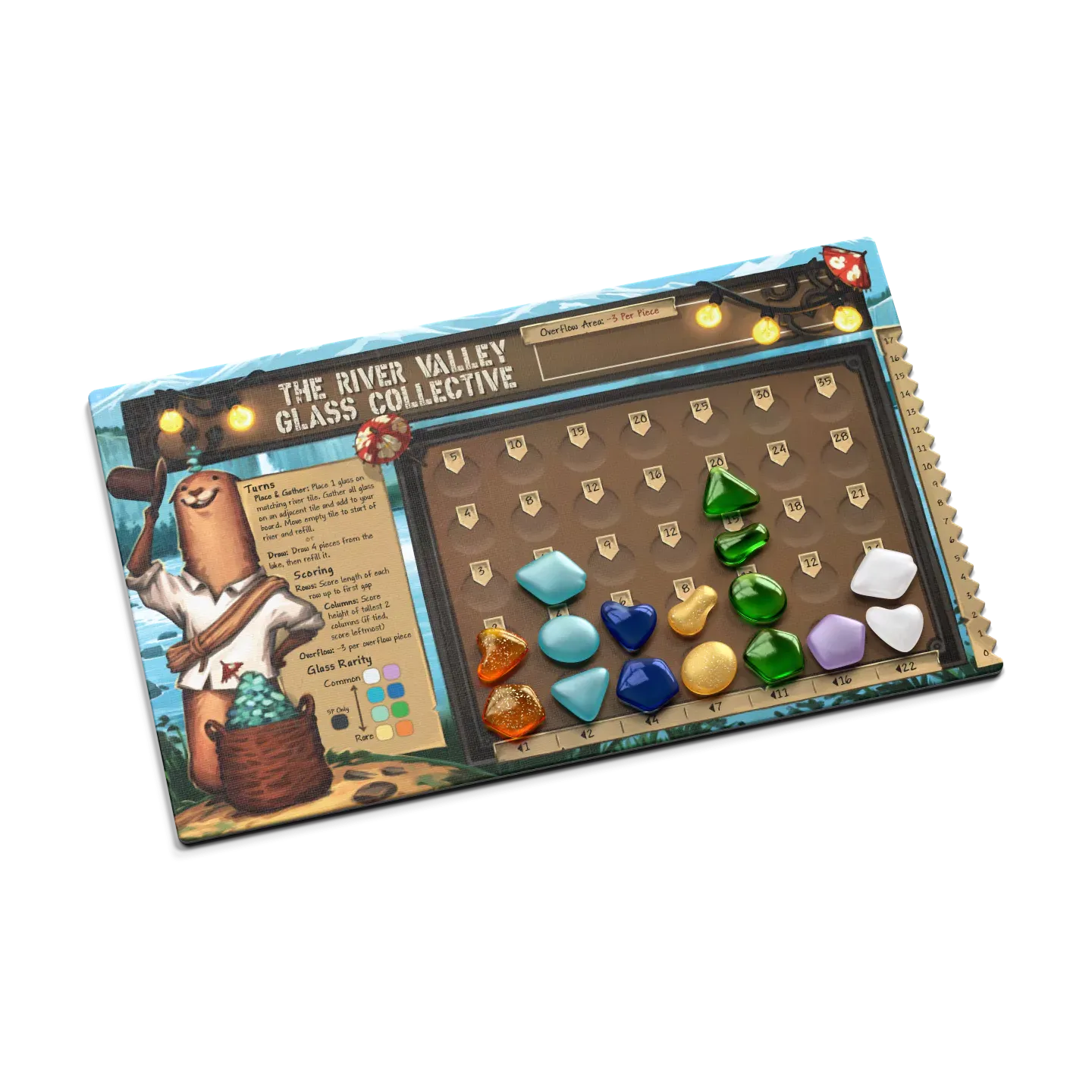
In River Valley Glassworks you try and collect the most glass, or really glass in the best columns to score the most points. Scoring is done in both rows and columns. When you score a column you score your two highest columns, and if there is a tie, the ones further left, because they give fewer points. And for rows, you score each row that starts on the left edge and then as far right as you can until you hit a gap. That’s mainly it for scoring, you might end up with negative tiles, but how you do that, we’ll talk about as I go through how you play.
Your Actions
On your turn you place one tile from your bag onto the river. When you place the tile you place it on the tile with the matching shape. The only way to break this rule is place out two matching shapes onto any location. Basically, two for one for a wild resource. Then you take the glass from either of the adjacent river sections. You place those pieces onto your scoring board. Each new color goes in a new column, and a repeated color goes to the next highest available row for that column.
When you are down to one glass piece tile or out of glass piece tiles you take four of the five glass pieces from the lake. That’s your other option and then you continue playing as normal. And you keep track of your glass pieces until you get up to 17 on your board or someone else does. Then everyone completes the round and there is one more round after that.
One thing you need to be aware of is filling columns and rows. It is good to do because you gain more points. However, if you take a piece of glass you can’t place, that goes into your trash area. Your trash counts for negative three points at the end of the game.
What Doesn’t Work?
I find that most of the game works for me. I think there is one element that is trickier to remember. That is keeping track of the stones. They give you a nice spot to tick that up, but it is trickier to remember. So it is something that only works so well. It’s not a major negative. But I think it is a piece that is easy to forget. So when you play River Valley Glassworks, it’s a rule to be aware of.
The other rule to be aware of, and again not a major negative, is the row scoring. I try and explain the row scoring at least twice. Why, because it rarely gets understood the first time. Or it is rarely understood until you play a few stones out. Maybe that is the best way, don’t teach the rule until everyone has taken two turns. For some people that is going to work. For other people, they want to know it right away.
What I Like
River Valley Glassworks is good for me because it is a simple game. I wrote out the actions and that is it for them. There is not a more complex action that I skipped. You either play out glass or you take glass from the lake. And then as you place on your board, that part is simple as well. So I love how easy it is to teach and play the game, besides the rule for scoring rows.
To go with that, River Valley Glassworks is a fast playing game. This is definitely because of limited options. But once you know what to do, you just figure out your best play and go for it. Sometimes it might require a little math in your head, but never too much. And the number of options is small enough that no single turn is going to take too long. And the longest turns happen at the end of the game in those last two rounds when you know it will end soon and you want to get as many points as you can.
I also appreciate the balance of luck and strategy. Some of it is that you get lucky with what is one the river sections. But there is some thought and strategy as to how you place it on your board. Certain colors of glass are less common. So I want those earlier because the more common are better later. Why, because they give you more points if you get a taller column. But at the same time, you want them earlier because that might mean you get more rows filled in. So it’s a nice balance of figuring out your strategy for that game and the luck of the glass.
Who Is This For?
I think that this is a great family game and a great filler game. Because of the ease to teach the game, it can come to the table fast. And there is basically no language in the game that you need to worry about. So as long as a kid can understand the scoring, they can play the game. What I want to do soon is try this as a soli game and see how that goes. Because it’s easy to get to the table and a lot of fun to play with all sorts of different groups.
Final Thoughts on River Valley Glassworks
I enjoy this game because it is that balance of luck and strategy. You certainly can plan to go one direction in the game, rows of columns and find that you pivot part way through because things weren’t going your way. But if things really seem like they aren’t, that’s okay. The game is fast and you just play it again. It’s nice for being a filler that way, or one that you might play multiple times in an evening.
I want to explore the solo mode still as well. I think that it will be one that I stream maybe next Wednesday (8/21/24) on Malts and Meeples. Because I want to know if it’s as fun, or if it’s less fun, because I can see it going either way.
And while I expect it won’t be for some people because of the luck. I think that a lot of people will enjoy it. And with the nice tactile nature of the game, this is one that should be popular. The question will be, is it a game that will break into the masses. Because it has that mass appeal to it, I think, which a lot of more hobby board games, or especially crowdfunding board games, tend to miss.
My Grade: B+
Casual Grade: A
Gamer Grade: C+
Send an Email
Message me on X at @TheScando
Visit us on Facebook here
Support us on Patreon here
Leave a Reply
You must be logged in to post a comment.