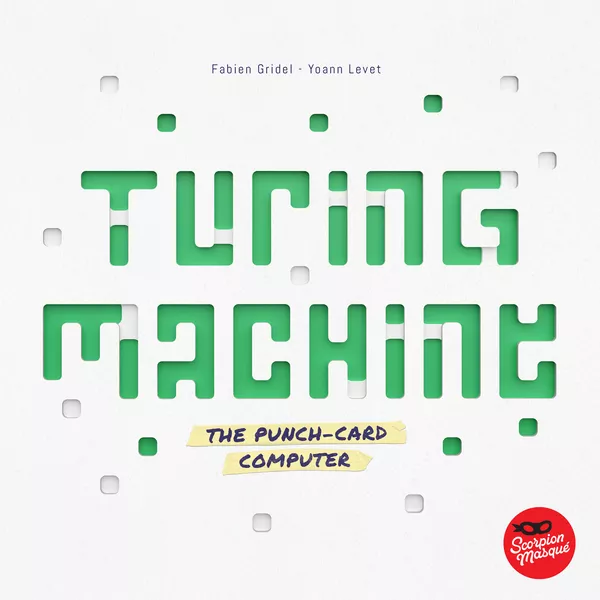
Turing Machine – Can You Crack The Code?
There is a new game that dropped on BGA (Board Game Arena) about solving a code. I plan on doing a review on that one later. But that brought Turing Machine back to my attention. I remember the hype for it when it came out and how everyone was all in on it at Gen Con. Turing Machine is a game that I thought looked maybe interesting but I wasn’t sure it would be a game for me. But then I gave it a try. Was I right and it wasn’t a game for me, or do I like Turing Machine?
How To Play Turing Machine
Turing Machine is a game where players compete to complete a three digit code. There are specific scenarios that you can do in the rule book. Or there is an app that has a ton more including daily challenges you can do for yourself.
So how does this work? Well, each player in secret creates a three digit code. Then they compare that against three (or fewer) of the criteria. Based off of the results, whether is passes or fails the criteria, someone either guesses or you keep going and create new numbers. The person who can solve the puzzle in the fewest rounds and queries is the winner.
So How Does It Work?
When you create a number you take some tiles. These tiles correspond with the number and color. You start by layering your first number on the bottom and stack up from there. Then you take the criteria card and flip it over so that the back side is on on the back of your number. It will show you a single opening which is going to correspond to a true or false assertion.
Which now asks, what are those assertions? It might be something like, the purple number is even or odd. Or it could be, there is a pair or numbers in the number, true or false. Now those both are very binary in nature. Either it is true that there is a pair of matching numbers or not. But others might be more complex. Is the yellow number greater than purple and blue, or is purple greater than yellow or blue, or is blue greater than purple or yellow. That has three options. So when you check, you know if only one of those is true or false, the one you are testing for based on your number.
Deduction and Guessing
As you test things you start to eliminate numbers and options as you go. The order is always the same as to what color number is first. And the rules will always let you nail down a single option. One of the big learning elements of the game is about figuring out how to create numbers that maybe make a certain assertion irrelevant because you figure out that answer another way.
When you decide that you know it, you get a guess. If you make your guess you complete it. If multiple people guess on the same round of the game, you check and see who completed it in the fewest number of checks. And if it is the same, both people tie.
What Doesn’t Work
I got nothing for this section. But the possible negative for the game going to be talked about in who it is for. Because it’s not really a negative, it is just important information.
What Works
The quality of the system is great. Now I only have played it on BGA, so I don’t own it, yet. But it is one that I want to get. And I want to get it because it is slick how it sets up and how you can play. They do a good job of making everything clear for setting up a puzzle without giving anything away.
That leads into ease of play. Being able to grab a scenario from online at the difficulty that you want is great. And it can go from standard, to harder to extremely hard depending on what parameters you put it. But no matter the difficulty level they make it easy to set-up.
I appreciate the changing difficulty levels as well. It really let’s me puzzle through at the level I want for a given play of the game. And it definitely does ramp up the challenge. I know people who would quickly be up for the challenges at the higher level. I also know people who would probably never want to move up to a higher level. Or at least it would take a while. So I like that selecting the level.
Who is Turing Machine For?
This is a hard logic puzzle. This doesn’t mean that it’s hard, per se. What is means is that there is nothing more than logic in the game. If you don’t like just sitting down and puzzling out what is happening this game is not for you. And it is a brain burner. I think it is a game that some people will know they won’t like. I think it is a game that after playing once you know if you like it or not as well.
Final Thoughts and Grade on Turing Machine
I find that I enjoy this game a lot. Turing Machine is a lot of fun, in doses. Now, I think I want to own a copy of it. Mainly because I want to, when I have an office space, set it up and leave it set-up so I can play the daily puzzle every day. And once in a while I might take it down to play with others, but it’d be a good brain burner to start a day with.
That said, I also know that this is not a game for everyone. So as I think about adding it to my collection, it is more about adding it for myself versus adding it to play with others. It is a great puzzle and thinky game. The downside is that it is purely a game where you are doing logic and deduction. It is great for some people and horrible for others, it just depends on how your mind works. And for me, I can make it work.
My Grade: A-
Gamer Grade: A or F
Casual Grade: A or F
Strategy (out of 10) – think logic: 9
Luck (out of 10): 0
Obviously a note on that gamer and casual grade. This is not a game that distinguishes between gamers or non-gamers. You might be better off being a gamer to learn the rules. But if you love a good logic puzzle but aren’t a gamer, you might love this game. If you are a gamer but you hate logic puzzles you won’t like this game. It is hard to give a grade beyond how much I like it, which is quite a lot.
Send an Email
Message me on X at @TheScando
Visit us on Facebook here
Support us on Patreon here
Leave a Reply
You must be logged in to post a comment.