
Heat: Pedal to the Metal – Table Top Takes
Let’s take to the track in on of the hottest games from the last two years. I’ve finally gotten Heat: Pedal to the Metal to the table. And is it the racing game that I was looking for with a lot of fast action? Or is Heat: Pedal to the Metal still a slower board game experience? That’s what I want to dive in and find out if Heat: Pedal to the Metal is a good game for me, and help you know if it’s a good game for you.
How to Play Heat: Pedal to the Metal
Like I said, Heat is a racing game. It’s about getting around the track the fastest. And if you finish on the same turn, it’s about being the one that goes the furthest ahead across the finish line. It’s what you’d expect for a racing game.
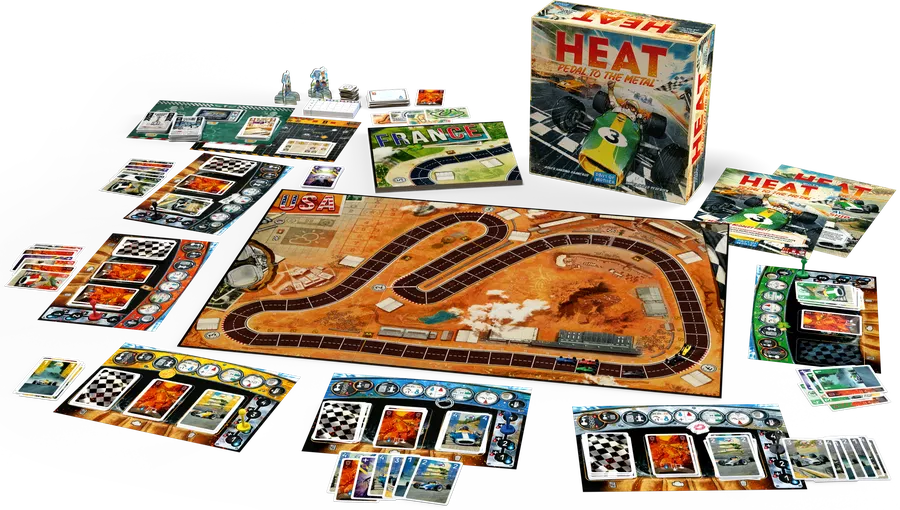
The game can most simply be broken down into three parts. Though the round structure has eight or nine, it is mainly three. First, you pick the gear you want to be in. You can go up or down by one for free, or for two with a cost. Then you play the number of cards for the gear you are in. Both of these are done at the same time.
Then, in turn order, players play out their cards and go that fast. There are several other things that can be done in this step. Sometimes you are flipping cards to go more of a random distance and pushing your luck that way. Otherwise, you might catch up to another card and draft off of them. Or things like cooling down your heat based off the gear that you’re in. All to push yourself past the turns and to the finish faster than everyone else.
How Heat Works
I think that the Heat in Heat deserves it’s own section. Mainly because this is how you break what you are doing in the game. I talked about the penalty of going up two on your gear shifter, that’s giving you heat. Heat also allows you to push yourself around a turn too fast. You spend your difference in speed to the corner speed as heat.
Heat then is your valuable resource for the push your luck element of the game. And every car only has a limited amount of heat. But as you are in lower gears, first or second, you return heat from your hand to your engine. Basically, as you push the car less it cools down so you are less apt to overheat it or spinout.
I really enjoy this mechanism in the game. It, I think, as well as as card play, are the crux of how the game works. If I push to hard and too fast early, I need to adjust my strategy at other times to get it back. But if I’m too cautious with it, now I drop behind and all that heat I have saved might not be enough to let me push around enough corners fast enough.
Stress Cards
So, heat clogs up your deck. But there are other cards that are in your deck of movement cards that can help, or they can hurt. Stress cards give you risk, but also might give you a lot of reward. You must play out the number of cards for the gear you are in. Sometimes that might mean playing a card that only moves you one. But if you’re on a straightaway, that isn’t that good for you. Moving one is only good around a corner if you come in with too high a gear.
Instead, playing out a stress card might be more helpful. They are supposed to be like a momentary lapse of judgement. Basically, you play out that card you and flip a random card from your deck. It is limited to what it can be, though. If I flip, I flip until I get one of my basic cards. So I know that the range can be from one up to four. So it might be worth it, of course, I might draw another one. Or I might draw a four that pushes me past a turn.
Turns
Before we kind of wrap up talking about the game in it’s parts, I want to talk about turns. Turns, as I’ve alluded to can give you heat. It’s pretty simple as to how turns work. As you reach a turn, it tells you how fast you can take that turn. I believe that the range of speed is as high of seven on some tracks and a low of two.
So as you reach turns, you need to maintain speed up to them, but then you need to shift down so that you can navigate the turn without going too fast. But if a turn has seven on it, and I go eight, I just gain a single heat card into my discard. So something that clogs up the deck, but not horribly. And if that gets me past a turn, it might be worth it. So it’s part of the push your luck of the game.
Basic Game vs Modules
So Heat offers you multiple experiences out of the box. You can play, and I recommend it, the basic version the first game. I ended up playing it the first two, just so that we knew what we were doing. That lets everyone keep their deck the same. It’s an even playing field and is a fun epxerience.
But as you gain comfortability with the game, you can add in modules. You might decide to add in weather which is going to affect how the track performs. Or there might be hazards or difficulties on the track you can add in.
But I think the big one is upgrades. Your deck contains twelve basic cards. Three of each card numbered one through four. In the basic game, everyone has a zero, a five, and an extra heat card that go into the deck. Drafting, those cards come out, and you pick your specific cards. Or you draft from cards three times so that you replace those cards. And the cards you draft might go faster, or offer more variability, or let you draft better. They change up how you might want to focus on the strategy of your game in a very fun way.
Plus, there are modules for racing a championship. So you might want to do that can run a few races. I haven’t played with those yet, but I’m planning on it.
Is It Fast?
So let’s answer the question that I asked at the beginning of the article. Is Heat a fast game? Often times racing games can run into an issue. I take my turn and my car moves. You take your turn, and if you play with five or six people, it can take a while to get back to my turn again. And that doesn’t feel like a car race. Watching Nascar, Indy, or Formula 1, they are all fast. And a car racing game should be fast.
I think that Heat improves upon this a lot compared to some other games. The first two phases, picking your gear and cards, those are done all at the same time. It’s only when you get to card play and moving distances that it goes in car order. And that is fast because it is just flip your cards and move that many spaces.
For the most part, I think Heat solves that issue. There might be some strategy or a couple of rounds in a game where it goes slower. Where someone wants to try and guess what other people have picked to get their right cards and right distance. But that is rare, so the game moves along well.
Who Is Heat For?
Heat is for people who want a fun racing game. It’s from Days of Wonder, so they tend to make more family weight games. They made games like Ticket to Ride, Small World, Five Tribes, and more. So it’s a racing game that I can pull off the shelf and play with anyone. I might not add in things like drafting or weather modules, but the base game is still a lot of fun.
That said, the game still works for more experienced gamers. It isn’t just a light filler game, there is strategy in what you are doing. And if you want to mess around with that you can. But it’s never so heavy and complex that it would keep more casual players from playing it.
Final Thoughts on Heat
I really like Heat. The expansion came out today and I pre-ordered it already. I want that seventh car and I want two more tracks. I’m sure it’ll come with more as well, but that’s mainly what I want from it. Heat works really well as a racing game, and I think it does hit that sweet spot of feeling like you are racing while not being too chaotic. But it’s also not bogged down int he game play either. For me all of that just works.
I do think that now that I’ve played with the drafting, I want to draft. Getting cards that really change up how you can attack the track is awesome. I might even teach with drafting. Especially if players are familiar with gaming at all. The drafting and those cards don’t offer too much additional complexity. But they add in just a little so that you can feel unique.
The one thing that I want to do is play with the dummy players. It is possible to play Heat solo. And maybe I’ll do that on a stream, or tonight, I might have some time to try it for myself. So my review is incomplete because I haven’t done that. But it would be fun to try that out and see how well that works for me.
Let me know your thoughts on Heat: Pedal to the Metal. Have you gotten it to the table? Do you enjoy it’s racing feel?
My Grade: A
Gamer Grade: B+
Casual Grade: A
Send an Email
Message me on Twitter at @TheScando
Visit us on Facebook here
Support us on Patreon here
Leave a Reply
You must be logged in to post a comment.