TableTopics: Concept
Concept is a game that’s pretty different from ones we’ve talked about before. I would qualify it as a party game — one that isn’t all that competitive and that leaves both room to talk and room to focus on the game. I played this game for the first time last night — read on to experience the game from the perspective of someone playing it for the first time.
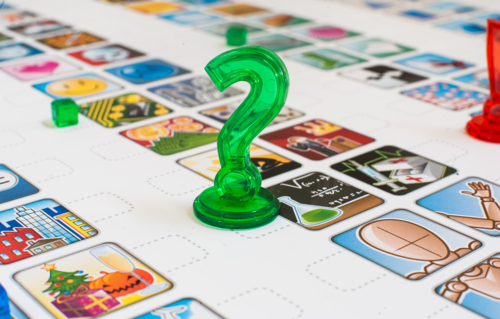
I was originally introduced to this game on TableTop, Wil Wheaton’s tabletop gaming show. My view of it then and my thoughts after playing it myself are actually surprisingly similar. This game can best be described as one that’s similar to Pictionary, but instead of drawing something, players use a board that shows several dozen images with certain meanings attached to them to express a word or phrase on the card they’ve chosen.

The game uses different colored tokens; using the large green question mark means that you are explaining the main concept of the person, place, thing, phrase, or idea that you’ve chosen from the card. There are also exclamation points that are used to signify sub-concepts, and small colored cubes that can be placed beside other squares to describe an item even more specifically. So, for example, if I picked an easy clue like “teacher,” I would put the question mark down on the occupation square. Then, using the small cubes, I would expand on that idea by placing the cubes beside other squares, such as the one that signifies the arts, or the one for math and science.
This game is very interesting in that it forces the player to think outside of the normal realm that we are used to in games. You have to combine seemingly random clues to express something like Sonic the Hedgehog (male, fictional, and blue could be enough to get the players to guess it), or to try to describe a more complex concept like “absent-minded.” The game does a really good job of challenging the players to think outside the box and figure out how to combine different concepts into a single focused concept.
It does have some of the flaws, however, that come up a lot with party games. Players tend to pick the easiest term, or the funniest, and this will eventually lead to repeats. Also, the game play is very much the same turn after turn. When you get a male character, either historical or fictional, the main concept goes on male, the second one goes on one of the other two, and you end up with a lot of guesses along the same line.
Now, when I played the game, we only played through a limited number of cards, so the pool of ideas would likely expand over time, but just from the handful of cards I saw, you’d almost always start with thing, person, female, or male (or a combination thereof) to describe most concepts. The other flaw I noticed is the fact that sometimes you just get stuck. Sometimes a person has a single way of thinking of something, or feels like they’ve already defined the term well enough (and probably have) even though no one can guess it, and you just end up with the players going in circles, and the person who is trying to make them guess what it really is starts scrounging through the different options to see how they can expand upon it or focus it back in. As they did on TableTop, we played with a “shame” meter — if you felt bad enough about not being able to get people to guess your concept, you would give up at that point. The issue with this is that it doesn’t add any real urgency to the game play, and there’s nothing else really tying people into the game, so it can lose focus from time to time.
Overall, the best way that I can describe how much I enjoyed this game is that it is one that I would like my friends to have so I can play it sometimes but don’t have to invest in it myself. It’s a fun game to play once in a while, but like many party games, it ends up being somewhat repetitive and could lead to a stale playing experience if it’s played too often. This is a good game for applying a mindset that Kristen has and has taught me to think about — the idea that it’s best to quit while you are still having fun. This is the kind of game that could drag on and become boring if you aren’t careful, but if you quit while you’re still enjoying it (which is easy to do, since, with the way we were playing it, there wasn’t a real ending to the game) you’ll have a good time playing it.
Overall Grade: C
Gamer Grade: D
Casual Grade: B
Leave a Reply
You must be logged in to post a comment.