
TableTopTakes: Grove by Side Room Games
Using the Orchard setup of nine cards, Grove promised a twist on that, however slight it might be. And I’ve played Orchard a lot, over 500 times in the past few years. So I really like Orchard, but will Grove from Side Room Games pass it up? Or does it even do enough different?
How To Play Grove?
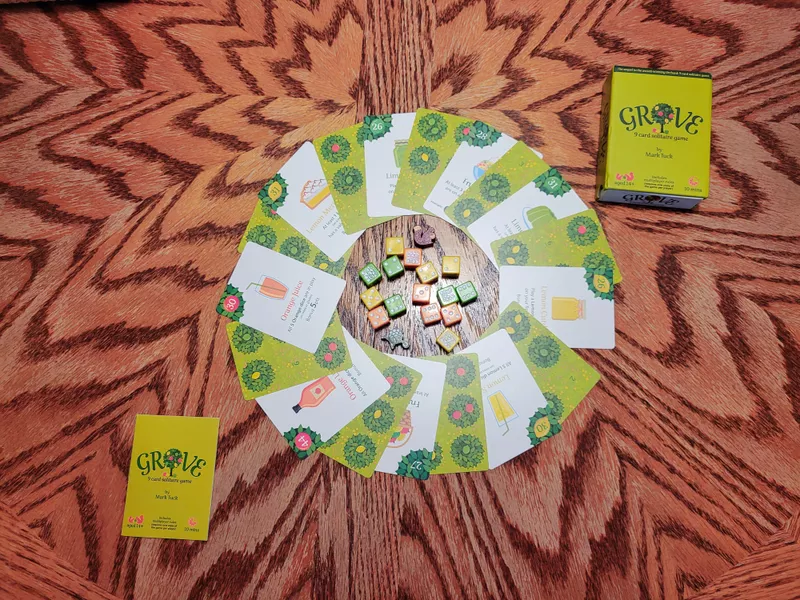
Grove can be played in two different ways, so let’s talk about the basic way first. Grove is a 9 card game with an 18 card deck. You use half of the cards and you are trying to layer cards so that you match like trees. When you layer cards you bump up the value of the tree being scored in that spot by one. So if I layer a lemon tree with one lemon and a lemon tree with two lemons, I place a die with the three face up. Then if I layer again with a two lemon, I go up to five. The goal is to get the highest total possible.
However, Grove offers two things to not make a match. Firstly, you can layer glades over anything. So empty spots on a card. Over a tree of some time, you can do that and now put another tree down there. Or over a die, you can do that, the die stays, and you can grow that tree type again. Or there is a squirrel, it allows you to break a match completely, say oranges onto a lemon, but it kills that spot. And that spot as well as any adjacent scores -1 point.
Then you just add up the pips on the dice and that is your score. How you score doesn’t change with challenge mode, but challenge mode changes what you target to score.
Challenge Mode
The other way to play the game is a challenge mode. On the backs of each card is a scoring challenge. So you pick two out of the deck of unused cards at random and you try and score those. That can vary from two times the score of oranges, or have all the limes in play, or get three lemons next to each other.
Each challenge gives you points as well as has a specific point total on the card. So maybe you get two times your orange score and get three lemons or any fruit next to each other. The double your oranges is 44 points and the three fruit adjacent is, let’s say, 28, so you’d need to score 72 points to win the game.
What Doesn’t Work?
The challenges are hard, and while they tried to balance it, I think that sometimes you just flip a challenge card, especially like get all 15 dice into play, and that’s not worth it. It’s a lot of effort, you keep the score of the dice you have in play low, and you don’t get enough points to offset the low dice or the target score. Now, being hard isn’t the issue here, it is the balance.
The other question is how long does the game play work? Especially the base game, I don’t know that it is better than Orchard. If you are just looking at layering cards, I think that Orchard offers the same puzzle, without the glades and squirrel, just rotten apples, that creates a more interesting game play.
What Works?

Like Orchard, the game play is very fast for Grove. I have played it over 100 times in the month of January, I’ll probably play it over 400 times throughout the year. Why, I use it as a palate cleanse when I have a few minutes between meetings at work. Or over lunch as I want to keep my brain engaged and busy, but I don’t want to work through lunch. And it doesn’t take up much room.
I also really enjoy the challenges. Yes, some of them I feel like are less balanced. But my negative of how long the game play will stay interesting is really taken care of by the challenges. It gives you that extra puzzle to work towards. Yes, some might not be worth trying to score, but depending on the cards you get, it might be. It really depends and I think that it works really well for the game.
Who Is It For?
This is for the solo gamer or the gamer who is looking for that palate cleansing game. I use it after a long day or like I said at work between meetings. It is the same area that I use Orchard for. And I have two copies of Orchard, one for work and one for home, and I’ll likely do the same with Grove. But if you are like me and like small solo games, Orchard is going to be a good option.
Final Thoughts on Grove
Grove, I was worried when I backed it on Kickstarter. My concern were the challenges, was it going to make the game too complex. How was scoring going to work and would it take a simple experience and drive the complexity up. What works so well with Orchard is how clean and simple it is. Grove, in all fairness, does make you think more, especially with the challenges.
But the challenges don’t add in complexity to the game. It makes some choices harder, but the game is still as simple to get the table. And I really appreciate the twist now on the game. Like I said, if I play base game, I will play Orchard. It offers more satisfying game play for me, but with the challenges, Grove offers more puzzle to it than Orchard.
My Grade: A-
Gamer Grade: A-
Casual Grade: B-
Send an Email
Message me on Twitter at @TheScando
Visit us on Facebook here
Support us on Patreon here
1 Comment