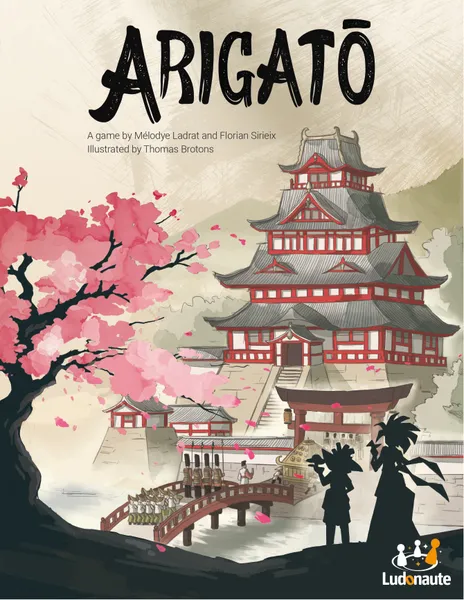
Arigato – Artisan Management 101
Another new to me game from Board Game Arena, BGA, is Arigato. This game is all about managing your different artisans in your village. And then completing their offering and sending them to give that offering and bring in new artisans. Plus a bit more, but it’s one of those games that is all about creating your engine and knowing how and when to break it to rebuild it. But is Arigato with all of that going on a good game? Or is it just a lot of work for little reward?
How to Play Arigato
Arigato is all about getting the most points that you can. You do this in a few ways, by sending workers to deliver their offering. You get points for artisans in your village, potentially, and you get points for completing the main objectives. At the end of 12 rounds, the person with the most points is the winner.
10 of the 12 rounds are going have those main objectives to complete. The objectives might be about having a number of artisans in your village with offering tokens, different or same resources, or total of number of artisans who have given an offering and more. The more of them you complete, the more points you get from them.
Morning Phase
You play the game over a few phases. The first one is the morning phase. In the morning phase you get five artisans and you split them into three groups. One artisan goes into your village. Each artisan is limited, and the card shows, as to where you can place them in your village. If you want to place an artisan and a spot is blocked you can discard an artisan from that spot to place them.
The other divide the other four two and two. Two artisans will get discarded for resources based off of their color. And the other two artisans get passed to your opponent at the start of the next day or round. Those will be used to create their new hand of five artisans.
Day Phase
During the day phase you flip over your cards, all are played face down, and you gain resources for them. You check and see if any of the artisans in town have an ability to trigger. Generally these abilities either give you more points or they give you more resources. Some abilities also trigger in the dusk phase, but we won’t cover that phase right now.
Then you spend your resources to place offering tokens onto your artisans. Just because an artisan has an offering token on it does not mean you need to move it to deliver that offering immediately. You might find that you don’t have the right combination of resources to complete offerings. If you want, you can trade two items in for one of another type. Once an artisan has an offering token on it, you can send them to deliver that offering whenever you want.
Dusk Phase
At the Dusk Phase a few things can happen, but the biggest is you check and see if you completed the objective for the day. If you did, you mark that with taking a token. And you also check and see if any of your artisans have things that would be triggered at dusk. The final thing that happens at dusk, though I might be off on order, is you discard your resources to get down to seven total. This is fairly rare that you will find yourself with more.
The game, like I said, ends after twelve days. You check to see your score for all the main objectives you completed. Then you add up the points you have taken during the game, and the points on the artisans who have delivered offerings. The player with the most points is the winner.
What Doesn’t Work?
The one negative I can think of is that there are a good number of symbols. On the artisans in particular you need to know what each section does and when the village ability is going to activate and what one it is. This is an issue only at the beginning playing on BGA because the more you play, the more you know just from looking at the symbols.
My hope, though, is for the physical version of the game, there are player aids. You don’t need anything much for it, just let the players know what the symbols are for because there are enough of them that it’ll be annoying to reference the rule book or pass around the rule books.
What Works?
Phases
I think that the different phases work quite well. Mainly because everyone is doing them at the same time. So it is generally a solitaire game. That means, though, that no player is going to have that much downtime. It’ll mainly just be waiting for the other players to complete their phase. And the phases are simple enough that it shouldn’t take too long.
With that comment about solitaire, I do want to comment about how it’s not purely solitaire. It is best to select cards in the dawn phase that is best for yourself. But if you find that you are not getting what you need, you also are able to pass on cards so that your opponent next turn is less likely to get what they need. It is a minor interaction, but can be a useful one at times.
Scoring
I really like the scoring in the game as well. All three elements work well in Arigato. I like that I can plan for those main objectives to get them, though, it’s improbable that you’ll get them all. But if you just go for those objectives, someone can score a lot of points from the artisans in their village and make up ground. And also getting a lot of artisans to deliver offerings is worth a lot of points.
Engine Building
Finally, the engine building in the village is fun. It adds to what you are thinking about when you pick which card to add or what cards to pass or keep for resources. You can go for a village that kicks out a ton of resources and rotate that and really focus on getting offerings delivered. Or you might go for one that doesn’t produce as many but is going to give you a lot of points from villagers. It’s up to you, and I like that variety.
Who Is Arigato For?
I think that people who like engine building are going to like like Arigato. But it is nice that it is not a massive engine that you build. It is only ever four artisans and often fewer. So this one is going to work well for that engine building but also for people who want to learn engine building. The drawback is, of course, the symbols, but that is common with engine building games.
Final Thoughts and Grade on Arigato
I really like Arigato. Even though my first play is not great, because of all the symbols, every play after I feel like I learn more and more about the game. And it is fun to explore the engine building that is done. Especially since it is possible for it to go different ways and how you can use them to your advantage in those different ways. If the village were larger it might feel like a lot of upkeep, but four artisans in your village is the perfect amount for the game.
It is also nice that all the turns are at the same time. Again, that often lends itself to being a bit more solitaire in nature. But in Arigato that isn’t a bad thing. Like I said, it is possible to toss some cards to your opponent that they might not want. But that is not the focus of the game. I like a game where it feels like what I do is awesome, and I can mess with you a little bit. Arigato is a game like that.
My Grade: A
Gamer Grade: B+
Casual Grade: C+
Luck (out of 10): 4
Strategy (out of 10): 5
Send an Email
Message me on X at @TheScando
Visit us on Facebook here
Support us on Patreon here
Leave a Reply
You must be logged in to post a comment.