
What Are Story Adventure or Puzzle Books?
Most people are familiar with Choose Your Own Adventure books, or maybe even the Choose Your Own Adventure board game. This isn’t really what I’m talking about, but they are are the basis of what has become a small niche of gaming, in some ways. These books, however, are more than that, taking upon that idea and the idea of brain teasers and turning it into something more.
But What Are They?
These books fall into two categories. The first keeps more to the classic rules of a Choose Your Own Adventure Book, you go through the book, making decisions and your choice will direct you to another page. However, they build upon them by giving you small puzzles to solve, clues to look for, and maybe even some rules or stats that you incorporate for the character that you are playing in that book. These are really that adventure books of the two type that I’m talking about.
The other type is the puzzle books, Some of these fall into the brain teaser book category. Generally the brain teasers will give you some clues upon completion which will then help you with the next brain teaser or some down the line. But there are also some of these books that more heavily link together the puzzles with story and you unlock certain areas of the story or the world by completing the story.
Why Do You “Play” Them?
For me, growing up, I really liked brain teasers, I wasn’t always the best at them, but I wasn’t terrible at them. I’d checkout books of brain teasers from the library and I’d like to see if I could figure out the cases in the Encyclopedia Brown books. The Choose Your Own Adventure books were less interesting, too chaotic for me, but I got them as well, just not as often. I also loved puzzle video games like Myst, Riven, Return to Zork and others where it was all about trying to solve those crazy hard puzzles.
So, that’s why I play find these puzzle and story books interesting, but why might one play them? It’s a good solo experience for one. Sure, there are some, and I’ll give an example later, that can be played with multiple people, but for the most part it’s just you going through them. It’s less work than setting up a board game and playing something like an escape room style board game by yourself. They are also nice because you can pick them up and put them down really easily. I have one that I haven’t looked at since around Christmas that I need to get back to and it’ll be simple to jump back in. Really, these games are a way to challenge yourself mentally without having to pull out something bigger and a good way to pass a chunk of time without just throwing on the television.
What Are Some Examples?
Graphic Novel Adventures
This is a series of books that have been put out by Van Ryder games. These are the closest to the Choose Your Own Adventure books. It, as the name implies, is in graphic novel form. What keeps it from just being a choose your own adventure is the fact you have a character sheet. In the one that I have, Loup Garou, you gain XP, you get equipment and have stats that you u se in the game. It makes the choices that you make in the game feel like they have more weight behind them. This is also where you can also get a multiplayer version, versus something that is primarily solo. They have The Crusoe Crew, one that has a bit more of a younger audience focus, where the different kids, depending on if they are tall or strong, might see different things or be able to interact with a panel of the graphic novel in different ways from their own book.
Journal 29
This moves into the area of more a pure brain teaser/puzzle book. Brain teasers are often scenario based or have some set-up to them and then are a one off thing to figure out, this is more abstract than that. In Journal 29, you figure out how to solve a puzzle, you go to a website, punch in your answer, it’ll tell you if you got it right or wrong. I like that about it, because almost everyone has a smart phone and can check an answer anywhere, but you won’t go online to try and figure out anything, it’s all just in the book. Journal 29 also has you using the solutions to other puzzles to help give some direction for future puzzles. It builds up nicely and has a good mix of hard and easier puzzles as you go through.
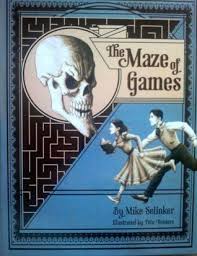
The Maze of Games
This one is kind of a step up from Journal 29 in that The Maze of Games has a whole lot more story to it. Sure, it’s about the puzzle, but you play as two kids who get sucked into a book, basically and they need to navigate their way through sections. This one also has you bouncing around in the book, so I’m guessing that previous answer might help in upcoming puzzles. An example of a puzzle here is the printed representation of one of those letter wheel/cylinders. I’m sure they have a real name, I just don’t know it, where you are trying to line up the letters to create the phrase, this is a 13 by 13 grid that you need to adjust to get it figured out. It’s a lot and I’m still working my way through that one. But I really like the fact that it has a narrative to go along with the puzzles.
Those are just three examples, there are more out there as well. I am getting a book, Alba, which is currently on Kickstarter. This one seems to have more story in it and be focused on adventure as much as on a puzzle. So I’m really interested to see how it works. I know for some people they won’t like these because they might be stressful, but I find them a lot of fun, and a good way to spend a bit of time.
Have you ever done anything like a puzzle book or an adventure book before? Is there a theme that would draw you in?
Email us at nerdologists@gmail.com
Message me directly on Twitter at @TheScando
Visit us on Facebook here.
Leave a Reply
You must be logged in to post a comment.