
TableTopTakes: Calico by Flatout Games
So not too long ago I did my Beyond the Box Cover of Calico and 3 Reasons Buy/Not Buy for Calico. But I got to play it more so I can give some more thoughts on the game and I want to do a full review and give it my grade. Some of this will be a repeat of what I’ve already done, but I do want to dive into this more. Calico is a very fun abstract game that has a theme I think a lot of people will like. It is an abstract game the theme of cats and quilting doesn’t matter that much, but it makes the game nice and cute.
How It Plays
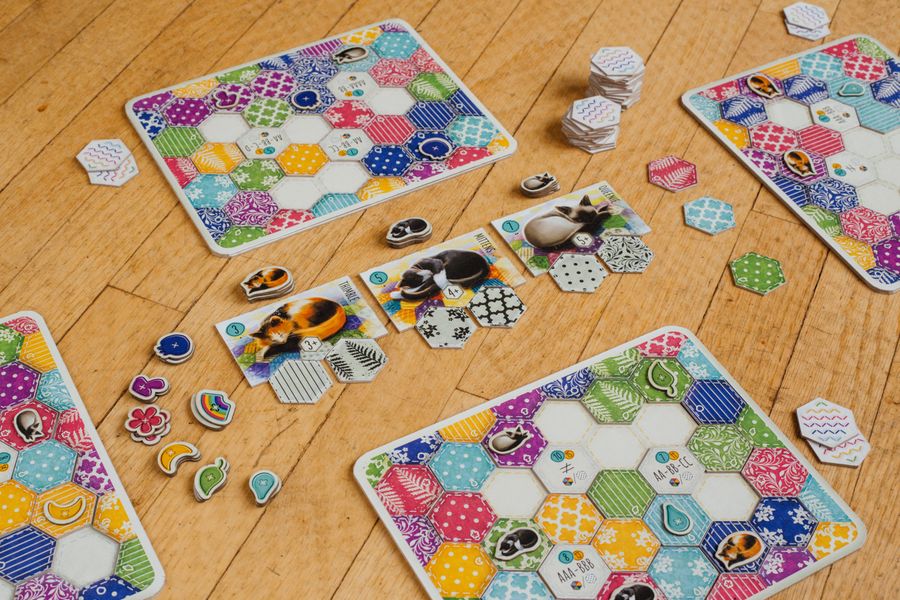
Calico is a very simple game. Your turn consists of taking a tile from two you have and putting it on your board. Then there three tiles out and you pick one of those tiles to add to your hand to bring it back up to two. You do that until you have your board filled. That is extremely simple, but the rest of the game is less so.
The rest of the game is how you score. There are three ways that you score points. The first is by getting matching colors. Groups of three or more of the same color get you a button. Buttons are worth three points at the end of the game. Then there are cats, they want certain patterns in certain shapes or size groupings. Cats can range from 3-11 points depending on which ones you are playing with.
Finally there are scoring tiles. These are tiles on the quilt that you need to place certain tiles around. You score points for getting colors or patterns around that tile that match it’s objective. For example, around the scoring tile it might want something like AA-BB-CC. So if you have two blue, to purple, and two green around it that’d give you a number of points. All of the objectives are like that, very simple, but tricky because there is overlap on them in that they’ll share tiles.
What Doesn’t Work?
For me, not much. I think one thing I need to get better at is one of the rules. When completing the pattern around a tile, say AA-BB-CC, you don’t need the two blues next to each other. While I never explicitly say that they need to be, people to assume that just because of how it’s printed. So it’ll be something that slows down or trips up players who don’t know that rule. I think that might hurt the fun for some players because you do need very specific things at times. So there are a few games, Criss Cross being another, where there is a specific rule or thing that needs to be emphasized.
While I think the artwork works for the game, I think it also will trick some people. This game looks very cute, and cute looking game, the assumption is that it’ll be fairly simple. This game has depth and a lot of decisions as you play it. The mechanics are simple enough to play with Grandma, but I’m not sure that all Grandma’s would be able to keep up with the decision making.
What Works?
Firstly the simple yet complex nature of the game. Turns are exceedingly easy because it’s placing a tile and taking a tile. The game with it’s artwork belies the depth that is in the game. There is a lot to think about when it comes to how you complete all of the goals. Do you focus more on cats or buttons? Do you try and get both patterns and colors for the scoring tiles? It’s a lot to consider and it works well. I really like this about the game, there isn’t a ton to keep track of in terms of game components, but there is a lot to think about.
I also like that you can’t plan perfectly in this game. There is no way to know what will be drawn out of the bag and available to draft. So there is no perfect strategy for the game, instead you need to adjust on the fly a little bit. This might make the game bad for some analysis paralysis players, but for me, it means that I don’t need to plan out my turns in advance. In fact with five tiles that I know about and only two being the ones I can play on a turn, it limits how much decision fatigue I can have.
The artwork stands out to me as well. The art is great from Beth Sobel and again it has a really friendly look to it. While I say that Grandma might not be able to keep up with the depth of it, but if you want to play a more hobby gamer game with less hobby gamers, this one is still good. The game feels like a challenge for gamers but is friendly enough for a lot of people because of the artwork.
My Final Thoughts
This is my type of game. Well, in terms of an abstract game anyways. I want something that I can do that’s a bit reactive and a good puzzle to figure out. Calico gives me a really good puzzle. And it’s worked well with the people I’ve played it with. And the theme is really cute. I don’t mind the quilt theme and I like cats, so that fact that it’s very accessible to a large group of people is good.
The complexity of decisions will keep it out of some players wheelhouse I feel. It is a thinkier game than it looks like, but still fun. I actually give three solid reasons as to why you might not want to buy this game in my 3 Reasons Buy/Not Buy. The video will be below so you can check it out. But for a lot of people who are just dabbling with gaming, I think it’d be a good fit.
My Grade: B+
Gamer Grade: B
Casual Grade: C
Email us at nerdologists@gmail.com
Message me directly on Twitter at @TheScando
Visit us on Facebook here.
Support us on Patreon here.
1 Comment