
What I Look For In An Abstract Game
Getting back onto this topic, what do I look for in a board game. Today we’re going to be diving into what I look for in an abstract game. Abstract games are generally not something I gravitate towards, though I do really love some abstract games, mainly because they often offer a more interesting mechanical puzzle.
What’s An Abstract Game
An abstract game is a game with no theme. Now, that’s not completely right because there are a lot of drier euro games that are euro games that really don’t have a theme. Generally an abstract game is going to be more of a puzzle or strategic game. They tend to have little luck, and give you the opportunity to strategize for a longer term plan.
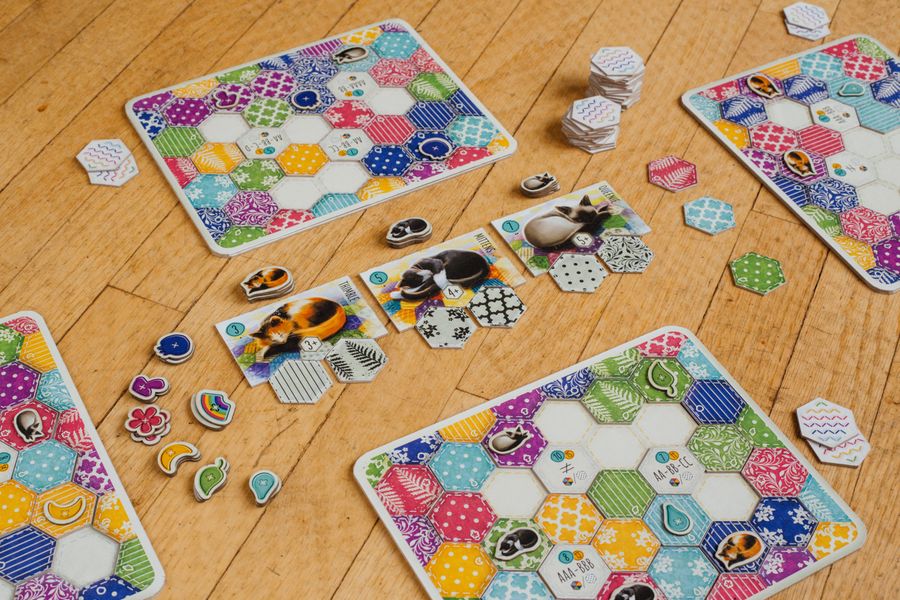
More recently abstract games have been getting themes but the theme tends not to matter. It’s more that recently abstract games have been getting artwork. A lot of the older ones are very simple with plain pieces, now things like Calico has great looking cat and quilt artwork on it. But it’s an abstract because the theme really doesn’t matter.
What Do I Look For In An Abstract Game
- Looks Good
- Easy To Learn
- Easy To Play
- Interesting Decision
Looks Good
Why is this at the top of my list? Because a lot of old abstract games look ugly. And kind of like eating, you play a game with your eyes first. If the game doesn’t look appealing on the table, I’m less apt to play it. Now, it can simply be nice looking colors or high quality wood pieces, like Quoridor. It doesn’t need to be like Calico with great artwork and cute cats. But make it look good, if it looks cheap I am going to pass on it most likely.
Easy to Learn
Next, I want the game to be easy to learn. If I have a lot of things that happen on a turn, I want theme, I want reason behind why they happen. That’s why I don’t mind if a big game like Gloomhaven has a lot of things to keep track of, I can remember them better when there is a theme behind it. For an abstract game, since they are thinkier sometimes, I want it to be easy to learn and easy thing to take care of.
Easy to Play
This falls in with the previous one. I want the game to be easy to play. That means again, I don’t want much to do on my turn. Give me a few specific things to think about. Again, if an abstract game limits the randomness, I don’t want to think about 12 different moving parts to make sure they are moving together toward the right goal.
Interesting Decisions
But with that ease of plan and being easy to learn, I still do want to have interesting decisions to make. I want to feel like I can do something clever. And I want to be able to plan my turns a little in advance, or at least think of options. If I have to react too much in an abstract game that leads to analysis paralysis. And since the games are dry, I want it to move at a snappy pace.
Are All Criteria Equally Important?
I think for a lot of people, especially people who like those extremely limited luck games, they might not see all of these as important. But I think for myself, these are all equally as important. I don’t want to spend too much time on an abstract game. I don’t want that abstract game, like Chess, where I need to think 5 moves ahead. Instead, I prefer that little bit of luck in my abstract games, and the ability to think about and plan my next turn right after I’ve finished my previous one.
Let’s Do An Example
We’re going to go with Calico. You can already see that I like Calico in my TableTopTakes. But why does it work for me?
Looks Good
No question about this one. Beth Sobel’s artwork is amazing and adorable for this one. And the quality of the game is really nice. The tiles are nice and thick, the player boards are dual layer, overall this is a really good looking game.
Easy To Learn
This game is pretty easy to learn. I think the trickiest bit is teaching how the scoring tiles on your quilt work. The cat scoring and button scoring make sense, but people often miss, even when laid out, that the tiles just need to match the pattern surrounding the quilt block and they can be mixed up while doing that. It’s more a rule that people assume is there. But the game turns are really easy to learn.
Easy To Play
This game is very easy to play. While it does give you a lot to think about the cats, buttons and quilt blocks all providing scoring, turns are simple. You play a quilt block and take a quilt block. That’s it. And you can plan what you are going to play down between turns. No player can mess that up, which makes the game work really well for me.
Interesting Decisions
This game does give you some feel good moments. You can really decide what you’re going to focus on, you might go all in on cats and pay less attention to buttons and quilt blocks. But really, you can’t completely ignore everything. So when you play down that one tile that works for the cats and the quilt block, that feels clever. You do have a lot to think about as you build out your quilt and even more to think about as your options shrink.
So Calico is a strong contender for an abstract game I think for a lot of people. With the exception of teaching the quilt block scoring, I think that the rest is pretty easy. And the artwork is so amazing that the game will hook peoples interest. I think that had this game not come out in 2020, people would be talking about it more than they are. And generally, Calico has been really well received.
Will This Work For You?
Yes, I think this will work for most people. While there are some people who are deep into games like Chess, I think for most gamers, having that simpler abstract game is going to hit a better spot. Mainly because a lot of abstract games a pretty accessible because they are simpler. That means you can get it played with more people. But do note that there are some abstract lifestyle type games out there, like Chess that wouldn’t fair as well with my criteria.
What is your favorite abstract game?
Email us at nerdologists@gmail.com
Message me directly on Twitter at @TheScando
Visit us on Facebook here.
Support us on Patreon here.
Leave a Reply
You must be logged in to post a comment.