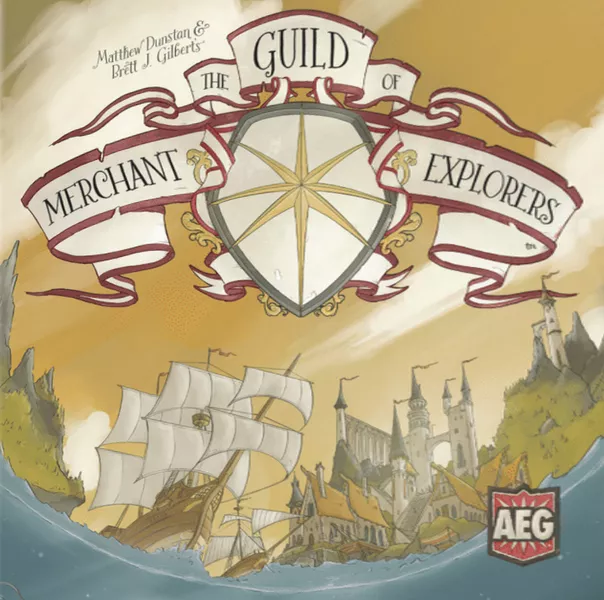
Guild of Merchant Explorers – BGA Game Of The Week
If you want to find a game with a boring title, I think that Guild of Merchant Explorers does a solid job. If you want to find a game with a dull board, again see this game. But are the name and the looks deceiving with this game? Is the Guild of Merchant Explorers actually a good game, or is the name telling the truth? Well, it’s one of the new ones that I’ve been playing on Board Game Arena (BGA) so let’s see how the game is.
How To Play Guild of Merchant Explorers
Guild of Merchant of Explorers plays kind of like a roll and write game, or flip and write game. So start by using that as a basis for how it is played. On a turn a card is flipped over and that tells you what type of terrain you can explore. And you want to explore terrain that has coins or is going to give you coins, because coins are your points at the end of the game.
Each card you flip has a certain way that or type of terrain that you need to place on. It might be wild but you need to place them so those two spots you are filling in are connected. Or it might be two grass lands which you can place anywhere, as long as they are connected to something previous, we’ll talk about that in a second. And then there are ones for each age that give you a special placement power that other players don’t have.
How To Place
So when you are placing you need to place off of a few different things, or a few different rules. When you start the game you need to start from your central city. And as you play, you can connect to paths leading back to that central city, or to villages that you’ve placed. I’ll talk about villages in a second. As you move from age one to two, and all the way up through four, you wipe what you have on the board each time, minus a few things.
So it might seems that you are always limited as you play out. But like I said you can play from villages as well. Villages do you give points, so one of the things you want to build to do well in the game. But they also give you new spots to build from. If I place a village on another island, I can now build off of that village. The rest of the rules apply still to what you are doing for placement, but you start in different spots.
And each era gives you a special card to use as well. Those special cards stick around, one for each era. And the one you pick and use in era one is going to be used in ages two through four as well. That is going to make how you expand compared to other players unique. And it is going to help determine your scoring strategy as you play the game.
How to Score
Then it’s all about how you score in this game. And the scoring is simple but there are a good number of ways to score. The first is simple, every time you cover up a coin, you gain that many coins. So if you cover up two coins on a turn, you get two coins which are two points at the end of the game.
You also gain coins for building villages. Earlier you build the village in a game the fewer points you will get. Why, because some spots are easier to build than others, so you likely will be building those to start the game.
You also explore spots with treasures. These give you a treasure card that you draw. Some of them give you points for the number of villages you have, or trade routes you create. Or it might be an urn that gives you more treasure for the number of urn cards you pull from the deck.
You establish trade routes as well. A trade route is going to connect two towns printed on the board. Not villages. You score points based on the numbers of your two connecting towns. And then you cover up one of the tows, so you can’t just connect the same high scoring towns again.
Finally each game you deal out shared objectives. The first player to complete it is going to get more points than the subsequent completion of those goals. And the most points at the end of the game wins.
What Doesn’t Work
There is an element of fiddliness that I expect to find when I play in person. On BGA it is great because it cleans up everything between rounds for you. When you play in person you need to remove all the cubes, but keep the villages in the right place. And that is going to be a bit more prone to a table bump or something like that. The game would be hard to make with a recessed board, and there are multiple boards, so I get it. But it is going to be a small concern.
What Works
Firstly, the card flip system and what you do with placing cubes is great. I really like how smoothly that works in the game. It is easy to track and use in the game. And it is nice because that means that everyone is playing the game at the same time. There is no roll or anything for a specific persons turn. I know a lot of roll and write style games do that now, as do more others, but it’s always nice.
I also like the cards you gather for each era. At the end of the game, I have three unique things that I can do. So, to make that clearer, in the final era, you activate all three, plus you choose one to activate again. So you decide, somewhat, how you build out your strategy. You get two cards each era that are special and choose to keep one, so while it might lead you in a direction, it is your choice.
And I like the scoring a lot in this game. I know it reads like a lot when it comes to what I wrote down for it. And that isn’t all the possible scoring in the game but nearly. So it is a bunch, but mainly, everything gives you coins. And on your first age, you probably get a village out and cover some coins. That is going to be about it. So it leads you into the scoring as you go and you can focus in on an area of scoring that you really want to make work for you.
Who Is Guild of Merchant Explorers For?
I think this is a great game for people who like roll and write games but want to bridge that gap between others. You play something that feels a bunch like a roll and write game, but it is still played on a board. The one thing I’ll say is that people looking for a very interactive game aren’t going to find it here. Which is okay but know that going into it. I was told by someone I play with on BGA that the game reminded him of Cartographers. And I think there is definitely an element that feels a bit like that. It is different, but if you like Cartographers you probably will enjoy this one.
Final Thoughts on Guild of Merchant Explorers
Now, I do like Cartographers a lot. So do I like Guild of Merchant explorers then? The answer is yes. This is a fun game that is easy to sit down and play on BGA and I think it’ll be easy to play in person. In fact, I plan on playing it in person sometime soon solo and competitively against other players.
I think what makes it so great for me is how the game expands out as you go. Yes, you wipe your progress between each era. And I though, or was worried, that it might make the game feel smaller and tighter. Mainly, can I make it to the edge of the board to get to that town there, or to cover up that area and put in a village. It turns out that the answer to those questions is yes, because if you start to place villages early, you really expand. And you add more cards each era as well.
There are some games that I play on BGA that I almost always have a game going. Forest Shuffle, Zenith, Rallyman Dirt and Pirates of Maracaibo, which I’ll talk about next week, are a few. I expect that Guild of Merchant Explorers is going to end up the same way. It’s an easy game to pick-up playing asynchronously and I enjoy that about it a lot. So a good easy game to play and enjoy, in my opinion. And a game that is going to give good variety and replayability and the possibility for expansions.
My Grade: A-
Strategy: B
Luck: C
Have you played Guild of Merchant Explorers? What do you think of it?
Send an Email
Message me on X at @TheScando
Visit us on Facebook here
Support us on Patreon here
1 Comment