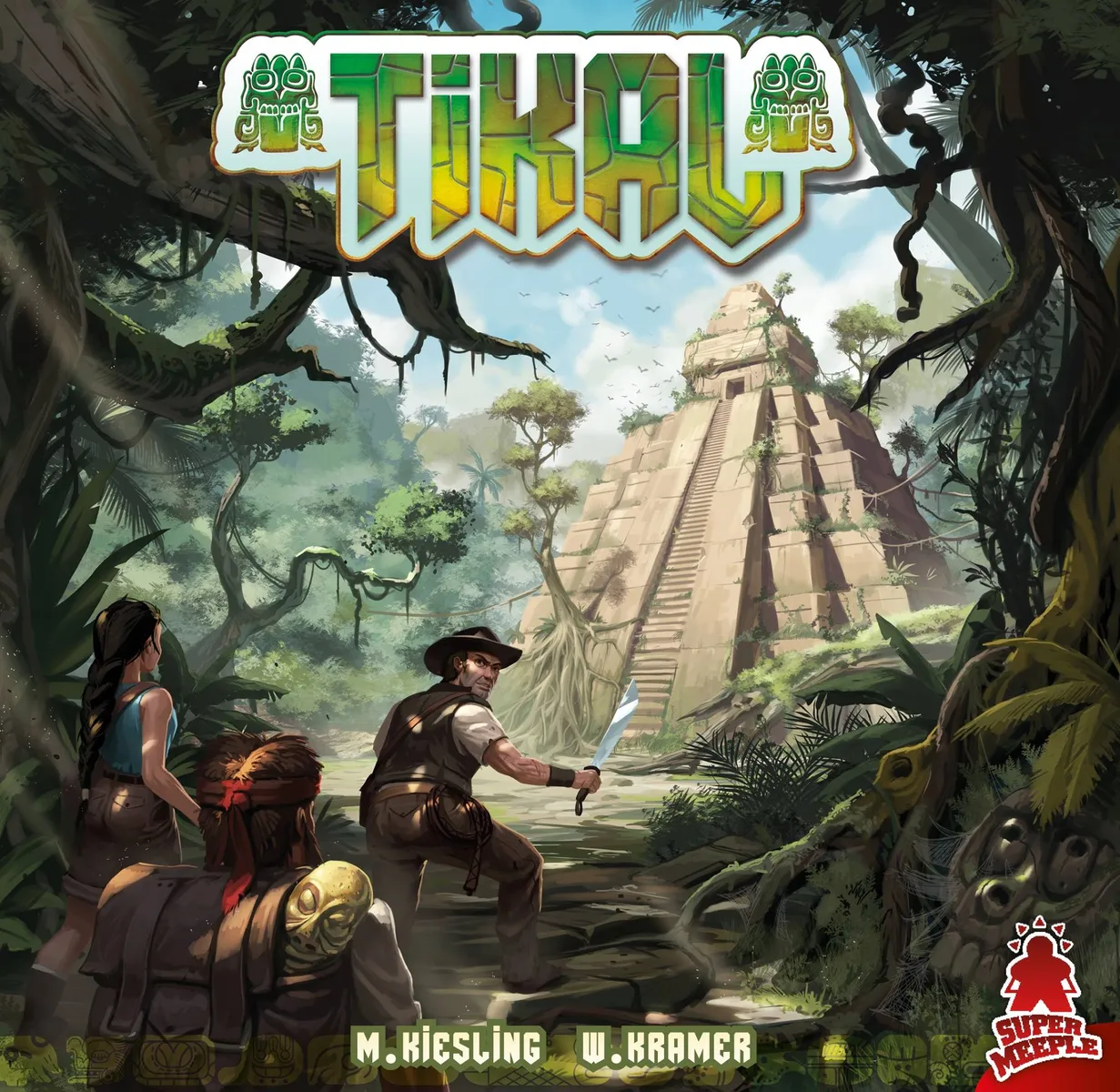
Tikal – Temple Exploring Area Control
New game to me this past week on BGA (Board Game Arena) was Tikal. This game wasn’t on my radar as one to checkout, but one of my BGA friends suggested it. Does it match my style of game, normally I am not that heavily into area control or direct conflict, or does it create area control in an interesting way. Let’s dive into how Tikal plays and what I like and dislike about it.
How To Play Tikal
In Tikal you want to get the most points. You get points for having treasures and majority at temple locations on scoring rounds. At the end of the game once all players take a scoring round the player with the most points is the winner of the game.
Two Part Turn
Turns are split into two parts, though the second part is where the majority of the turn is. So let’s talk quickly about that first part. On your turn the first thing you do is place a tile. It must be connected to another tile and accessible. To be accessible there must be a stone connection to another tile. If you draw a volcano you do a scoring round which we will talk about in the next section.
Once you place a tile you are able to do up to 10 action points of actions. The different actions cost different action points. I won’t go through all of them, just some highlighted ones.
- Place a worker
- Move a worker paying action points for stones that you cross
- Uncover part of a pyramid
- Find a treasure
Like I said, there are more, but these are some of the highlighted ones. When you uncover part of a pyramid you make it taller. The taller it gets the more points it is worth in a scoring round. And when you find a treasure, it is set collection. The more of a type of treasure that you have, the more points they are worth in a scoring round.
Scoring Rounds
The other big element is the scoring round. When a volcano tile is going to be placed each player takes a scoring turn. On your turn you don’t draw and place a tile. Instead you just spend action points to take the actions defined above, plus any of the others you want.
At the end of your scoring turn, you score points for temples that you own the majority at and for treasures you have. Then the next player takes a scoring turn. So it is possible that multiple players might score a temple as majority changes as they move workers.
What Doesn’t Work
No real complaints for this one. Because of how scoring works the area control is not too in your face. But you do need to pay attention and manage a few things based off of what your opponents are doing. Probably the biggest thing that might get some people is when placing tiles you can maybe mess or block off areas temporarily to limit how your opponent can build out. That is the most negative interaction in the game and it’s not very negative.
The other slight negative is that the treasures are less impactful in scoring. Having a lot can help, but scoring temples that are worth a lot of points is just better, for the most part. But some of my negative opinion with them might be me messing up my scoring in the first game. Still it is more luck based to see if you can create sets because sets are worth more points, if it’s just a one off, that is a wasted action to get it in some ways.
What Works
Firstly, I really like how the Tikal scoring works. I messed that up big time in my first game. That’s not an issue to mess it up in a game as long as you learn from it. But I like that it isn’t just straight area control. If I take control of an area I get the points for it. Then if you score after me, you can move in and gain control of that area. Now I might block that if I can cap it off so that the temple is completed, an action I didn’t mention, but that is limiting points in the future for me as well.
Let’s talk about that capping off action. You need majority. And it is going to cost you all of your workers there. And they don’t go back into the worker pool, they are just gone. So that is a nice tradeoff as you decide what to do. Do I want to have a ton of workers available further into the game, or if we fight over a spot is it worth spending a number of workers to lock in that scoring every scoring round?
I like the action point system in Tikal as well. I think that it’s pretty slick and easy to understand. Once you take a turn you generally know the actions. There is also nice strategy in figuring out how you want to spend your actions or when you should put out a tent, an action that costs five action points, to help you get into the further reaches of the jungle.
Who Is Tikal For?
I think that Tikal is a game for people who like that action point management and that feeling of exploring while optimizing your scoring. Now that is saying a lot. It is less of a puzzle than some games, say Lost Ruins of Arnak, with a similar theme. So this one is pretty welcoming game and easy to understand and play.
It is not going to be a game that I’d introduce someone to as their first game. It is also probably not going to be a game where heavy euro gamers are going to feel like there is enough going on. But it’s that nice welcoming action point game for people who have played a few games, like Catan and Carcassonne, and they want a bit more.
Final Thoughts and Grade on Tikal
I really enjoy this game and system. I was not sure I was going to when I started, but it is easy to learn and play. Like I said the one thing that tripped me up was that I score at the end of my turn on a scoring turn. I easily could have gotten more points the first game had I remembered. That is a rule that I would drill into the heads of people I play with at the start of the game and then remind them at the scoring round. It is something unique about the game, so something to remind about.
This is a game that I want to add to my collection. Now, I know there are a lot of games like that which I play on BGA. I think that Tikal is a good one because there is a bit more going on to it and some things that make it feel unique as compared to other games in my collection. And I like it because it is quite easy to teach. Even with all the actions, I assume there is a cheat sheet like on BGA, that the players can see what everything costs. So it makes teaching the game faster and easier to get Tikal to the table.
My Grade: A-
Gamer Grade: B
Casual Grade: B
Strategy (out of 10): 6
Luck (out of 10): 2
Send an Email
Message me on X at @TheScando
Visit us on Facebook here
Support us on Patreon here
Leave a Reply
You must be logged in to post a comment.